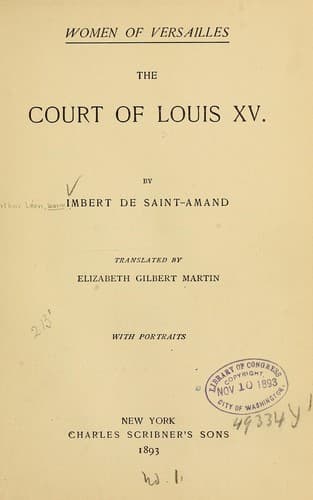
France -- Court and courtiers; France -- History -- Louis XV, 1715-1774
There are characters which can only expand in a better world. Sorrow
had undermined the constitution of Madame Henriette. She died February
10, 1752. “Ah! my sister! my dear sister!” were her last words. She
died as she had lived: while loving. “Sad sport of fate,” says M.
Honoré Bonhomme, “poor saintly girl, virgin and martyr, who spent nine
whole years in climbing, step after step, the Calvary where she yielded
up her soul.”
After relating this death, the Duke de Luynes adds: “No one can
express the sadness into which the King is plunged. The Queen is much
afflicted, and also the Dauphin, Madame the Dauphiness, and Mesdames.
Madame Adelaide does not weep, but silent griefs are usually the
longest. Madame Henriette was much beloved. Her mild character, without
ill temper and even without will, rendered her extremely complaisant
toward the Dauphin, the Dauphiness, and the ladies, her sisters.”
On receiving tidings of this mournful death, Madame Infanta wrote her
father a most touching letter. She said she wished to come and mingle
her tears with those of her family. She arrived in France in September,
1752, and remained with her father for a year.
Madame Infanta was not happy. She did not greatly esteem her husband,
and that Prince cut a rather sorry figure in the little sovereignty of
Parma and Piacenza. He had neither money nor prestige; and his wife,
who was very intelligent, his wife, of whom Bernis said that she would
make a good minister of foreign affairs, was constantly dreaming of
some more considerable establishment for him. She thought by turns
of exchanging the Duchy of Parma for Tuscany, or acquisitions in
Flanders, Lorraine, or even Corsica. She fancied that, thanks to her
father’s affection and the territorial changes in Europe, she would
end by obtaining something. The Marquis d’Argenson, who had not much
sympathy for her, wrote, September 27, 1753: “It is to be hoped she
will never come back to France. Is it just that the State should suffer
because she was married so badly? Along with her go a great quantity of
chariots loaded with all sorts of things that the King has given her.”
Madame Infanta returned to France a third time, but only to die there.
She arrived at the château of Choisy, September 3, 1757. To credit M.
Michelet, it was she alone who brought about the Seven Years’ War. But
there is no foundation for this assertion of the great writer who,
toward the close of his life, created what one might call the school of
imaginative history. At the time when she reappeared at court, Madame
Infanta was glowing with freshness, brilliancy, and health. No one
could have foreseen that her death was so near at hand. One of her last
letters was addressed to her son Ferdinand, whom she had left at Parma.
It commenced as follows:--
Public-domain text, read in full here on John Shaqi.
Reviews
Reviews
No reviews yet
Be the first to share your thoughts on this work.
Elsewhere in the archive
Join the Discussion
Join the discussion
Sign in to leave a comment or review.
Sign InorCreate an account