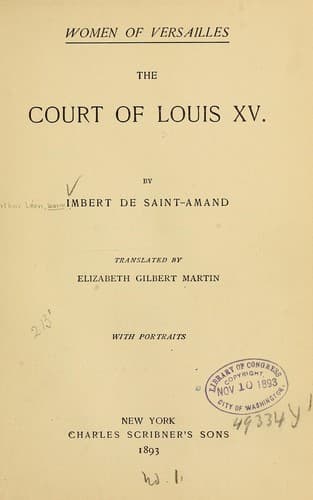
France -- Court and courtiers; France -- History -- Louis XV, 1715-1774
“Life is uncertain, my son, and my character is too sincere for me
either to vaunt or even to affect perfect indifference as to the length
of mine; but I feel that the wish to see you, to leave you worthy of
the name you bear in the world, such, in fine, as I desire you, is
one of the ties that attach me most to life, and one of the reasons,
perhaps, which will most abridge mine by the continual torments caused
me by this desire and the fear of not obtaining it. It will be a great
consolation to be able to leave you an avowal of my sentiments if I die
before you are in a condition to read it. If I live, it will serve me
as a plan whereon to form you; and in either case, it will always be to
you a proof of my tenderness and of my care for your welfare at an age
when many people do not yet think of it.”
Not many days after writing this letter, Madame Infanta was attacked
by small-pox, and died December 6, 1759. The twins, who had loved each
other so tenderly, both died prematurely. Madame Henriette had died at
the age of twenty-four, Madame Infanta at thirty-two. She was buried at
Saint Denis, close to her sister, so that their union lasted even in
the tomb.
Marie Leczinska’s heart was broken with grief. But instead of murmuring
against Providence, she bent filially beneath the hand of God who smote
her. Her five remaining children, the Dauphin, Adelaide, Victoire,
Sophie, and Louise, showed her a profound affection. Never was a
mother better loved. Louis XV. took pleasure in the society of his
daughters. As a father, he had that sort of citizenlike good-nature
which is unhappily rare among princes. Mesdames lodged underneath
their father, in the former apartment of Madame de Montespan. Madame
Adelaide occupied a chamber which communicated by a private staircase
with that of her father. “Often,” relates Madame Campan in her Memoirs,
“he brought and drank coffee there which he had made himself. Madame
Adelaide pulled a bell-rope, which announced the King’s visit to Madame
Victoire. On rising to go to her sister, Madame Victoire rang for
Madame Sophie, who in her turn rang for Madame Louise.”
Public-domain text, read in full here on John Shaqi.
Reviews
Reviews
No reviews yet
Be the first to share your thoughts on this work.
Elsewhere in the archive
Join the Discussion
Join the discussion
Sign in to leave a comment or review.
Sign InorCreate an account