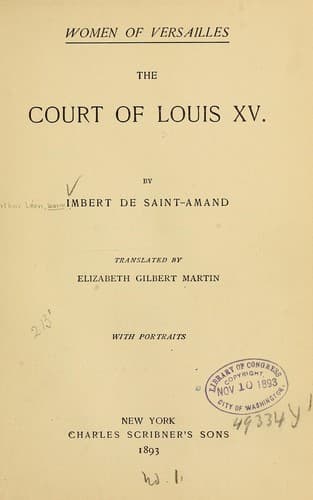
France -- Court and courtiers; France -- History -- Louis XV, 1715-1774
This etiquette which weighed upon royal families was a heavy burden,
an excessive fatigue. For two days the Dauphiness had eaten nothing.
“Her great fatigue is the cause of this,” the Marshal wrote again to
Augustus III.; “and I have told the King that if she could not have
some rest she would fall ill. Indeed, I don’t know how she can avoid
it. I am completely knocked up with following her. It is so hot in
all the apartments, what with the quantity of people and the candles
in the evening, that it is enough to kill one. And besides that, her
clothes are so heavy that I don’t know how she has been able to carry
them. What is still more fatiguing are all these endless presentations;
and she wishes to remember all the names, which is a terrible task to
a mind incessantly occupied, moreover, in trying to please and show
attentions. The other day the King made me take up her skirt which lay
on a sofa. It weighed, at least, sixty pounds; not one of our cuirasses
weighs as much. I don’t know how the Princess could have remained on
her feet eight or nine hours with that enormous weight.”
Marie Josèphe knew how to make herself esteemed and loved. A courtier,
who admired the graces and virtues of this good and beautiful
Dauphiness, said: “Nobody ought to take a wife anywhere but in Saxony;
and rather than dispense with a Saxon wife, when there are no more, I
will make one out of porcelain.” Marie Leczinska forgot the quarrels
that had existed between the house of Saxony and her father for the
throne of Poland. She became tenderly attached to her daughter-in-law,
and showed her an almost maternal love.
The Dauphiness was delivered, September 13, 1751, of a son, who bore
the title of Duke of Burgundy, and who died when nine years old, after
long and horrible sufferings which he endured, a precocious Christian,
with admirable courage. The Marquis de Pompignan wrote a biography of
the little prince. Some years later, another child, likewise fated
to undergo tortures, learned to read in this book: it was that most
innocent of victims, the future Louis XVII. “How did my little uncle
manage to have already so much knowledge and goodness?” cried the
compassionate child.
The Duke of Berry was born August 23, 1754; the Count of Provence,
November 17, 1755; the Count of Artois, November 9, 1757. These three
princes were to be called Louis XVI., Louis XVIII., and Charles
X.,--three names which on their first appearance affect the imagination
with a nameless trouble, and transport it into an unprecedented world
of revolutions and catastrophes.
Marie Josèphe of Saxony had eight children, five only of whom survived
her; the three sons, who were all to reign, and two daughters, Madame
Clotilde, who was Queen of Sardinia, and another whose mere name evokes
the memory of the purest virtues, the profoundest piety, the most
sublime sacrifices, the most heroic courage in sufferings, in prisons,
on the scaffold: Madame Elisabeth.
Public-domain text, read in full here on John Shaqi.
Reviews
Reviews
No reviews yet
Be the first to share your thoughts on this work.
Elsewhere in the archive
Join the Discussion
Join the discussion
Sign in to leave a comment or review.
Sign InorCreate an account