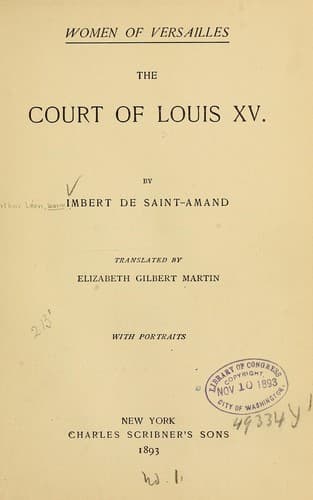
France -- Court and courtiers; France -- History -- Louis XV, 1715-1774
The question, however, was more serious than one might be inclined to
believe. Jansenism, that third estate of religion, as it has been so
justly called, was nothing more or less than a preliminary step toward
republican doctrines. “Do not believe,” said Bossuet, apropos of the
English revolution, “that it is simply the quarrel of the Episcopate,
or some intrigues against the Anglican liturgy which have moved the
common people. These disputes were as yet only feeble commencements
whereby turbulent spirits made a trial of their liberty; but something
more violent was stirring in the depths of men’s hearts; it was a
secret disgust for all that had been authority, and an itching to
innovate incessantly after the first example had been seen.”
French Jansenism had the haughty chagrin, the indocile curiosity, the
spirit of revolt, which characterized the Protestantism of England.
Louis XIV., so jealous of his royal prerogatives, had seen this at
once. He felt that discipline is as indispensable to the Church as to
the barracks, and comprehended that the throne has the same foundations
as the altar. The thing aimed at by the bull _Unigenitus_ of 1713
was to re-establish unity in doctrines; and when the Jansenists refused
to submit to the decree of the Sovereign Pontiff, the great King said
that this rebellion against the Pope would give rise to attacks against
the monarchical principle. He was not mistaken. If the Parliament
showed itself favorable to Jansenism, it was far less on account of
such or such ideas on free will or grace, than by instinctive liking
for the revolutionary spirit which existed in germ in the new sect.
Religious controversies were to lead by slow degrees to political
controversies. The Parliament led to parliamentarism. People began by
contemning the episcopal jurisdiction of an archbishop in order to end
by braving the authority of a king.
Public-domain text, read in full here on John Shaqi.
Reviews
Reviews
No reviews yet
Be the first to share your thoughts on this work.
Elsewhere in the archive
Join the Discussion
Join the discussion
Sign in to leave a comment or review.
Sign InorCreate an account