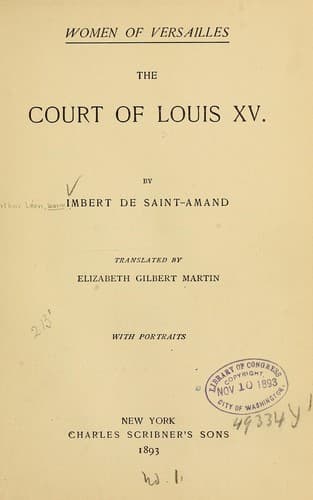
France -- Court and courtiers; France -- History -- Louis XV, 1715-1774
Christopher de Beaumont, that convinced priest, that austere and
inflexible prelate, so firm against the temptation of grandeurs that
Louis XV. had been obliged to summon him thrice in order to make him
leave his diocese of Vienne, in Dauphiny, and accept the archbishopric
of Paris, Christopher de Beaumont was faithful to the traditions of the
Church when he denied all competence over matters purely religious,
such as the administration of sacraments, to the Parliament. His
doctrine was after all only that of the separation of the powers.
Louis XV. inclined to the views of the Archbishop, whose virtues he
appreciated. Like Louis XIV., he recognized the bull _Unigenitus_,
and treated Jansenism as a heresy. Like Louis XIV., he suspected, not
without reason, both the Parliament and the Parisian population. “I
know the people of Paris,” said he; “they must have remonstrances and
shows, and perhaps worse than that some day.” Madame de Pompadour would
have taken the part of the Archbishop, as the King wished to do, if
the Archbishop had been a courtier; but Christopher de Beaumont would
rather have died than compromise with concubinage and adultery. He
could not understand a prelate’s stooping before a royal favorite,
and the idea of soliciting a Pompadour would have made him blush.
He preferred to be twice exiled. “The Queen,” wrote D’Argenson in
December, 1754, “Monseigneur the Dauphin, and all the royal family are
greatly troubled by the exile of the Archbishop of Paris; the Queen
weeps over it every day.” Christopher de Beaumont received numerous
visits in his exile at Conflans. The orthodox considered him the
upholder of the faith. The King admired the Archbishop, but did not
sustain him. D’Argenson wrote, March 6, 1756:--
“The motto _Dividatur_ might be recommended for the personal
government of Louis XV. He received this spirit of compromise from
Cardinal Fleury. All his forces run to that.... Hence, doing good
only half way, he also does evil half way, which produces a chaotic
state of things, and the worst effect.” With this system the monarch
dissatisfied the magistracy and the clergy at the same time. By turns
he banished the Parliament and the Archbishop. The curés continued to
refuse the sacraments to the Jansenists. The magistrates sent their
bailiffs’ men and caused the sick to be communicated surrounded by
bayonets. The Eucharist was abandoned to derision by the parties to the
strife. The court fluctuated between the two opinions. After having
sent the Archbishop of Paris to Conflans, Louis XV., although leaving
him in disgrace, pronounced in his favor.
Public-domain text, read in full here on John Shaqi.
Reviews
Reviews
No reviews yet
Be the first to share your thoughts on this work.
Elsewhere in the archive
Join the Discussion
Join the discussion
Sign in to leave a comment or review.
Sign InorCreate an account