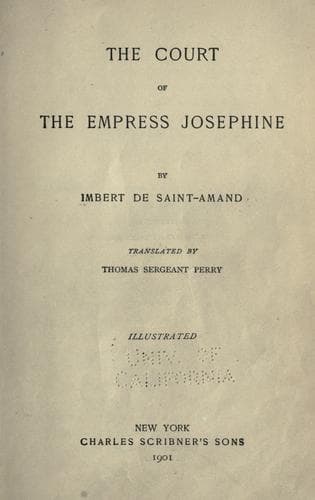
The Court of the Empress JosephineImbert de Saint-Amand
History
The Court of the Empress Josephine
Imbert de Saint-Amand
Josephine, Empress, consort of Napoleon I, Emperor of the French, 1763-1814
The Empress was ailing during a good part of her stay in Munich, and
whether for this reason or because Napoleon, who was always moving from
place to place, did not get his letters regularly, he was for some time
without news from his wife. He wrote to her from Brunn, December 10, 1805:
"It is a long time since I have heard from you. Have the grand festivities
of Baden, Stuttgart, and Munich made you forget the poor soldier who lives
covered with mud, rain, and blood? I am going to leave soon for Vienna.
They are trying to make peace. The Russians have left and are fleeing far
from here, going back to Russia badly beaten and sorely humiliated. I am
anxious to be with you once more. Good by, my dear; my eyes are well
again."
Napoleon wrote again December 19, renewing his complaint: "Great Empress,
not a letter from you since I left Strassburg. You have passed through
Baden, Stuttgart, Munich, without writing us a word. That is not very kind
or very affectionate! I am still at Brunn. The Russians are gone; we have
a truce. In a few days I shall see what is to become of me. Deign from the
giddy height of your grandeur to interest yourself a little in your
slaves."
From Schoenbrunn he wrote to Josephine, December 20, 1805 (29th Frimaire,
Year XIV.): "I have your letter of the 25th [Frimaire]. I am sorry to hear
that you are not well; that is not a good preparation for a journey of a
hundred leagues at this time of year. I don't know what I shall do; that
depends on what happens. I have no will of my own; I am waiting to see how
matters settle themselves. Stay at Munich, amuse yourself; that is not
hard, amid so many pleasant people, in such a charming country. I am
tolerably busy. In a few days I shall have made up my mind. Good by, my
dear."
December 26, peace was signed at Pressburg between France and Austria. The
treaty gave to the Kingdom of Italy, Istria, Dalmatia, and Friuli; to the
Elector of Wuertemberg, the title of King and the Suabian territory; to the
Elector of Baden, the Breisgau, Ortenau, and the town of Constanz; to the
Elector of Bavaria, the title of King, the Vorarlburg, and the Tyrol. But
Napoleon had determined that these indemnifications should be paid for by
three marriages,--that of his step-son, Prince Eugene, with the daughter
of the King of Bavaria; that of a relative of his wife, Mademoiselle
Stephanie de Beauharnais, with the hereditary Prince of Baden; that of his
brother Jerome with the daughter of the King of Wuertemberg.
Public-domain text, read in full here on John Shaqi.
Reviews
Reviews
No reviews yet
Be the first to share your thoughts on this work.
Elsewhere in the archive
Join the Discussion
Join the discussion
Sign in to leave a comment or review.
Sign InorCreate an account