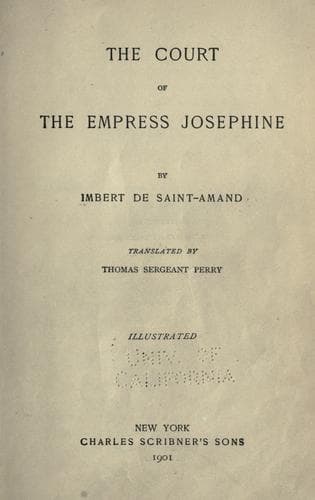
The Court of the Empress JosephineImbert de Saint-Amand
History
The Court of the Empress Josephine
Imbert de Saint-Amand
Josephine, Empress, consort of Napoleon I, Emperor of the French, 1763-1814
Napoleon, accompanied by Murat, entered Munich beneath an arch of triumph,
December 31, 1805, at a quarter to two in the morning. This entrance in
the night, lit up by torches, was very impressive. The next day, January
1, 1806, a herald-at-arms, escorted by numerous horsemen, passed through
the different quarters of the city, and read the following proclamation,
after a flourish of drums and trumpets, while an immense crowd gathering
in every street and crossway loudly applauded: "By the grace of God, the
dignity of the sovereign of Bavaria having recovered its old-time
splendor, and this State having resumed the rank it formerly held for the
happiness of its subjects and the glory of the country, be it known that
His Most Serene Highness the powerful Prince and Lord Maximilian Joseph
is, by these presents, solemnly proclaimed King of Bavaria and of all the
countries on it dependent. Long live and happily Maximilian Joseph, our
very gracious King! Long live, and happily, Caroline, our very gracious
Queen!" That evening the whole city was full of joy, and the next day was
celebrated as a national festivity.
Napoleon, having recaptured the twenty-nine cannon and the twenty-one
Bavarian flags that had fallen into the hands of the Austrians by the
chances of war and the occupation of the country, had decided to restore
to his faithful allies the trophies which they had valiantly defended and
whose loss they mourned. In the morning of January 2, all citizen soldiery
was under arms, lining the streets through which was to pass the
procession and their precious burden. The cannon were placed on carts
adorned with festoons and garlands, each cart was drawn by two horses
belonging to the citizens; the houses were also decorated with different
colored ribbons. All the young people in the city accompanied these carts.
The students of the Royal College of Cadets carried the flags. When the
procession reached the grand square, a large chorus, accompanied by a
large band, sang a song of thanksgiving and victory. The populace and the
soldiers mingled their cheers with this song. The procession then made its
way to the Church of Our Lady, where a _Te Deum_ was sung with great
solemnity.
Public-domain text, read in full here on John Shaqi.
Reviews
Reviews
No reviews yet
Be the first to share your thoughts on this work.
Elsewhere in the archive
Join the Discussion
Join the discussion
Sign in to leave a comment or review.
Sign InorCreate an account