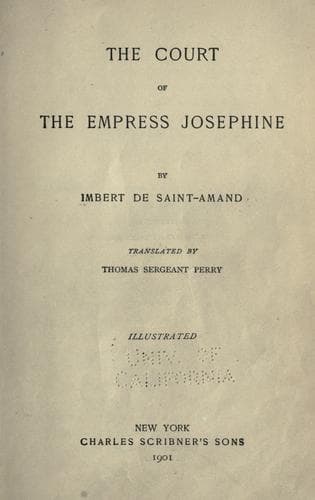
The Court of the Empress JosephineImbert de Saint-Amand
History
The Court of the Empress Josephine
Imbert de Saint-Amand
Josephine, Empress, consort of Napoleon I, Emperor of the French, 1763-1814
January 4, Napoleon wrote to Prince Eugene: "My Cousin,--Within twelve
hours at the most, after the receipt of this letter, you will start with
all speed for Munich. Try to get here as soon as possible, so that you may
be sure to see me. Leave your command in the hands of the general of
division whom you judge to be most capable and upright. You need not bring
a large suite. Start at once, and _incognito_, and so avoid both dangers
and delays. Send me a messenger to give me twenty-four hours' notice of
your arrival." The Emperor had decreed the marriage of his step-son with
Princess Augusta of Bavaria, but he had to go through certain formalities
to overcome the objections of the Queen of Bavaria, who wanted her
brother, the hereditary Prince of Baden, to marry the young Princess. Her
family pride and her inmost feelings revolted against the admission into
her family of a young man whom she looked on as an upstart. She sought for
pretexts and devices to delay, if not to prevent, this alliance. No one
would have dared to say at Munich that the Emperor's step-son was not
great enough to marry a king's daughter, but she found fictitious excuses:
it was said that the young Princess was ailing, and at another time that
she was suffering from a sprain. Napoleon, who sometimes played the
diplomatist, feigned to believe in these alleged ailments, and said that
he would send his own surgeon to heal her. He would gladly have returned
speedily to Paris, where he deemed that his presence was necessary, but
his Chamberlain, M. de Thiard, whom his previous negotiations had made
familiar with the secrets of the Bavarian court, advised him to stay in
Munich until the marriage was absolutely settled. "Very well," said the
Emperor; "but do you know that while I am here, your Faubourg Saint
Germain is making a run on my bank, and that my stay in Munich costs me
fifteen hundred thousand francs a day?" M. de Thiard insisted, and dared
to show Napoleon the Queen of Bavaria's ever-present recollection of the
Duke of Enghien, which was the secret cause of her aversion to the
projected alliance. But this opposition could hold out for only a few
hours; no one then dared to brave the Imperial wrath. The Queen, fearing
that Napoleon's surgeon would discover that the Princess's alleged
sufferings were only an excuse, yielded to the wishes of the hero of
Austerlitz. The marriage was announced even before the couple had met.
Everything was done in military fashion. Orders were issued that they
should love, and they loved.
There is this to be said in behalf of Napoleon; that in the whole matter
he made no use of harsh words or rough manners. He appeared in an
attractive, not in a threatening light, and by dint of appearing smitten
with the Queen of Bavaria, even aroused Josephine's jealousy.
Public-domain text, read in full here on John Shaqi.
Reviews
Reviews
No reviews yet
Be the first to share your thoughts on this work.
Elsewhere in the archive
Join the Discussion
Join the discussion
Sign in to leave a comment or review.
Sign InorCreate an account