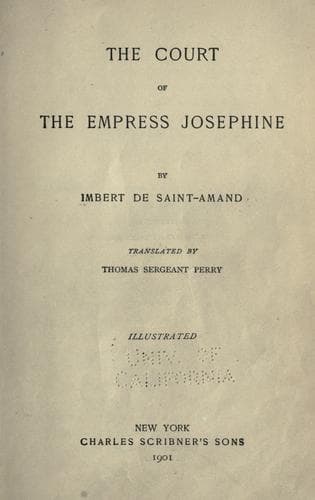
The Court of the Empress JosephineImbert de Saint-Amand
History
The Court of the Empress Josephine
Imbert de Saint-Amand
Josephine, Empress, consort of Napoleon I, Emperor of the French, 1763-1814
On her wedding day the Princess charmed every one by her grace. She was
tall, well shaped, with the figure of a nymph, and a face in which
sweetness was blended with dignity. Moreover, she was very well educated,
was pious and modest, and the possessor of all the family virtues. In
short, she was a model wife and mother. She wrote to the Emperor a letter
of thanks that touched him. He answered it, January 27: "My Daughter,--
Your letter is as amiable as you are yourself. My feelings for you will
only grow from day to day; this I know from my pleasure in recalling your
fine qualities, and from the need I feel for your frequent assurance that
you are satisfied with every one and happy with your husband. Amid all I
have to do, nothing will be dearer to me than the chance to assure my
children's happiness. Be sure, Augusta, that I love you like a father, and
that I count on a daughter's affection for me. Travel slowly, and be
careful in the new climate when you get there, and take plenty of rest."
January 21, Prince Eugene left Munich with his young wife for Milan. The
next day M. Otto, the French Minister, wrote to M. de Talleyrand: "His
Imperial Highness Prince Eugene left yesterday morning with his young
wife. The King escorted them to their carriage with every indication of
affection. It was noticed that in taking leave of the Prince he embraced
him several times. The separation cost the Princess some tears. Their
departure was announced by firing a hundred guns. The best wishes of all
good Bavarians accompanied the pair. The stay of the French court at
Munich has left the deepest and most lasting impression. The Emperor's
greatness and power were known, but the effect of his extreme kindness and
magnificence had to be seen at a closer view to be appreciated. I feel
able to assure His Majesty that the Bavarian nation will always be his
faithful and devoted allies. So many happy memories are attached to this
period of our history that His Majesty can flatter himself that he has
accomplished the most difficult of all conquests,--that of the love of the
people who have witnessed his successes."
Public-domain text, read in full here on John Shaqi.
Reviews
Reviews
No reviews yet
Be the first to share your thoughts on this work.
Elsewhere in the archive
Join the Discussion
Join the discussion
Sign in to leave a comment or review.
Sign InorCreate an account