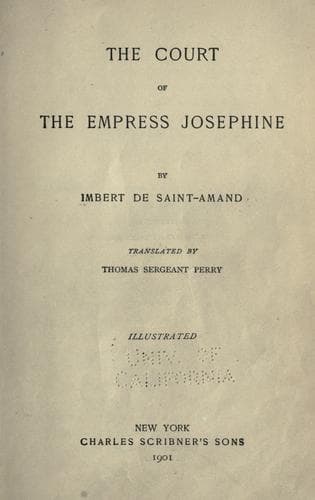
The Court of the Empress JosephineImbert de Saint-Amand
History
The Court of the Empress Josephine
Imbert de Saint-Amand
Josephine, Empress, consort of Napoleon I, Emperor of the French, 1763-1814
While the Viceroy and Vice-Queen of Italy were proceeding towards Milan,
the Emperor and the Empress were on their way to France, stopping at
Stuttgart and Carlsruhe, where they were warmly greeted. January 20, 1806,
they found an arch of triumph built on a Roman model at Entzberg, in
Baden. It bore this inscription: _Imperatori Napoleoni triumphatori
augusto_. The bas-relief represented the capture of Ulm and the delivery
of the keys of Vienna. Columns and obelisks had been erected at Carlsruhe
with these inscriptions: _Hostium victori.--Patriam servavit.--Pacem
restituit_. In front of the castle had been built a temple of Peace. At
the French frontier stood an arch of triumph with this inscription: _Heroi
reduci Galliae plaudunt_,--"Gaul applauds the returning hero." The bas-
reliefs represented the battle of Austerlitz and the interview between the
two Emperors. In the night of January 26, Napoleon and Josephine were back
at the Tuileries. Prince Eugene's marriage put a happy ending to the
campaign just finished. To create a king and to give to his step-son the
hand of this king's daughter was a stroke of imagination on Napoleon's
part that did honor to his omnipotence. The accounts of the triumphal
festivities in Munich, Stuttgart, and Carlsruhe followed close upon the
bulletins announcing the victories of the Grand Army, and produced a great
impression in both Germany and France.
XVII.
PARIS IN THE BEGINNING OF 1806.
Napoleon arranged his return with the utmost skill. His prolonged stay at
Munich kept alive the impatience of the Parisians for his return, and
meanwhile there was a constant stream of flattery and enthusiasm. January
1, 1806, had just put an end to the Republican calendar, which had existed
for thirteen years, three months, and a few days. The Year XIV. found
itself suddenly interrupted by the return to the Gregorian calendar. Thus
vanished the last trace of the Republic. The same day the new year was
inaugurated with a patriotic ceremony. The Tribune carried with great
solemnity to the Senate the forty-four Russian and Austrian flags which
the hero of Austerlitz had entrusted to its care. All the houses in the
streets through which the procession was to pass were decorated. In front
of many of them were to be seen the Emperor's bust crowned with laurels.
The ever lyrical _Moniteur_ said: "At the sight of these noble spoils,
these startling proofs of the heroism of the French army, all hearts
seemed to meet in a common feeling of admiration and gratitude which was
but faintly expressed by the shouts issuing from the crowd and from every
window, of 'Long live the Emperor!' 'Hurrah for the Grand Army!' 'Victory,
victory!' 'Long live the Emperor!' It was in this way that the people of
Paris, of all classes, of both sexes, of all ages, manifested in the most
vivid and unanimous way their devotion and gratitude to His Majesty and
his victorious armies."
Public-domain text, read in full here on John Shaqi.
Reviews
Reviews
No reviews yet
Be the first to share your thoughts on this work.
Elsewhere in the archive
Join the Discussion
Join the discussion
Sign in to leave a comment or review.
Sign InorCreate an account