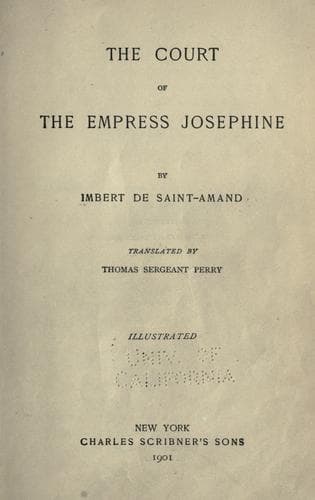
The Court of the Empress JosephineImbert de Saint-Amand
History
The Court of the Empress Josephine
Imbert de Saint-Amand
Josephine, Empress, consort of Napoleon I, Emperor of the French, 1763-1814
The marriage of Mademoiselle Stephanie de Beauharnais with the hereditary
Prince of Baden was at first warmly opposed by the Margravine, this
Prince's mother. M. Massias, French charge d'affaires at Baden, had
written on this matter to M. de Talleyrand, Minister of Foreign Affairs,
January 6, 1806: "My Lord,--For some days there has been a rumor quietly
circulating among the principal persons of the court of Carlsruhe that the
object of M. de Thiard's last journey was to arrange the marriage of the
Electoral Prince of Baden with the daughter of Senator Beauharnais. Last
evening arrived a messenger from the Electress of Bavaria for the
Margravine, the mother of this Prince. I have learned by chance the
contents of this missive to his mother. She says substantially that she
has had a talk of more than an hour with the Emperor Napoleon; that His
Majesty promised that the marriage of the Electoral Prince of Baden with
Mademoiselle Beauharnais should never take place without the consent of
the Margravine; and in case of her refusal of this consent, he would only
reserve to himself the right of being consulted on the choice of the wife
to be given to this young Prince.... The Electoral Prince called on his
mother after she had received this despatch, and was with her alone for
two hours; he came away in great dejection. When he got to his
grandfather's, he exclaimed, involuntarily, 'That woman is lost; she wants
to ruin herself!'"
The charge d'affaires ended his letter with this sketch of the Margravine:
"I have known the Margravine for six years, and I think I can say that if
she judges the match in question opposed to the pride inspired by the
first ideas of her education, no persuasion can move her. She possesses to
a very marked degree the confident obstinacy of feeble and timid spirits.
She does not dare to dismiss an incompetent footman; and when she has once
made up her mind, which is only possible in matters about which her
opinions are rigidly formed, neither force nor persuasion can modify her.
That is my reading of her character, and I think it the true one."
Public-domain text, read in full here on John Shaqi.
Reviews
Reviews
No reviews yet
Be the first to share your thoughts on this work.
Elsewhere in the archive
Join the Discussion
Join the discussion
Sign in to leave a comment or review.
Sign InorCreate an account