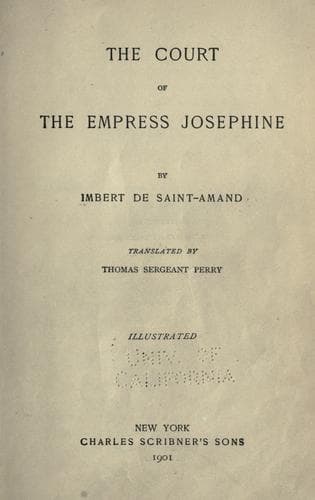
The Court of the Empress JosephineImbert de Saint-Amand
History
The Court of the Empress Josephine
Imbert de Saint-Amand
Josephine, Empress, consort of Napoleon I, Emperor of the French, 1763-1814
The more the Margravine opposed this match which the Emperor had
suggested, the more the young Prince of Baden and his grandfather, the
Elector, desired it. M. Massias wrote again to M. de Talleyrand, January
9, 1806: "His Most Serene Highness, the Prince Electoral of Baden, is to
leave tomorrow for Ulm and Augsburg, to invite, in his grandfather's name,
His Majesty the Emperor and King to honor Carlsruhe with his presence, and
to stay at the castle on his way back to France. But, he tells me himself,
the main object of his journey is to convince His Majesty that the
marriage of which I had the honor to speak to Your Excellency in my last
letter, is far from opposing his desires; and he hopes to dissipate
without difficulty the doubts which it has been sought to raise regarding
this in the mind of His Majesty, for whom he always manifested a profound
devotion and a sincere attachment."
What was the origin of this young girl whose hand was thus sought by the
hereditary Prince of Baden? The Marquis of Beauharnais, the father of the
Viscount of Beauharnais, the first husband of the Empress Josephine, had a
brother, Count Claude de Beauharnais, who was a commodore, and married
Mademoiselle Fanny Mouchard. Countess Fanny, a friend of Dorat and
Cubieres, took much interest in literature and wrote many novels. She was
a blue-stocking, and it was about her that Lebrun wrote the malicious
epigram:--
"Egle, fair and a poetess, has then two slight faults:
She makes her face and does not make her verses."
By her marriage with Count Claude de Beauharnais, the Countess Fanny (born
in 1738, died in 1813) had one son, named Claude after his father, who
married the daughter of the Count of Lezay-Marnesia. They had a daughter,
Stephanie de Beauharnais, born August 28, 1789, who was adopted by
Napoleon, married the hereditary Prince of Baden, became the grandduchess
of this country, and died in 1860, much loved by her family and the people
of Baden. Her father, Claude de Beauharnais, was a senator in the Empire,
a peer of France at the Restoration, and died in 1819.
Public-domain text, read in full here on John Shaqi.
Reviews
Reviews
No reviews yet
Be the first to share your thoughts on this work.
Elsewhere in the archive
Join the Discussion
Join the discussion
Sign in to leave a comment or review.
Sign InorCreate an account