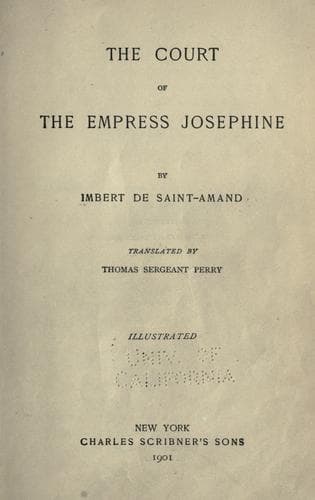
The Court of the Empress JosephineImbert de Saint-Amand
History
The Court of the Empress Josephine
Imbert de Saint-Amand
Josephine, Empress, consort of Napoleon I, Emperor of the French, 1763-1814
The vassalage of the new monarch was thus definitely established; he
remained Constable of the Empire; he was ordered to be French and not
Dutch. His first duties were to the Emperor, his brother and suzerain. He
respectfully approached the throne, and said with evident emotion: "Sire,
I have made it my highest ambition to sacrifice my life to Your Majesty's
service. I have made my happiness consist in admiring all those qualities
which make you so dear to those who, like me, have so often witnessed the
power and the effects of your genius; I may then be permitted to express
my regrets in leaving, but my life and my wishes belong to you. I shall go
to reign over Holland, since that nation desires it and Your Majesty
commands it. I shall be proud to reign over it; but, however glorious may
be the career thus opened to me, the assurance of Your Majesty's constant
protection, the love and patriotism of my new subjects, can alone inspire
me with the hope of healing the wounds of the many wars and events that
have crowded into a few years." After the royal speech the usher threw
open the door, and as in the time of Louis XIV., at the acceptation of the
Spanish accession, the new King was announced to the assembled crowd.
As M. Albert Reville says, no one in France regretted the Batavian
Republic when it was stricken from the roll of history by the will of a
despot; or, rather, the Parisians, in their occasionally exaggerated
infatuation, fancied that the Dutch would be overjoyed to have a French
court.
The next day, after breakfast, the Emperor was playing with the new King's
oldest son, the little Napoleon, who was only three years and a half old,
but was very bright for his age, and already knew by heart La Fontaine's
fables. The Emperor made him recite the fable about the frogs who wanted a
king, and listened to it, laughing loudly. He pinched the Queen's ear, and
asked her, "What do you say to that, Hortense?" The allusions to the poor
king and to his poor people were only too clear. The melancholy monarch,
or rather, the crowned monarch, was to be, according to the Emperor's
plan, a mere tool in the hands of his powerful brother. He was condemned
to discharge the functions of receiver of dues and of recruiting officer
in the Emperor's service. He had a presentiment of this degraded position,
and took his departure with much anxiety.
For Hortense, leaving was sadder. No exile ever turned towards foreign
parts with heavier sorrow. Her diadem was a crown of thorns. Her mother's
grief augmented her own. Without her children, Josephine, naturally
unambitious, found no consolation in the thought that her son was a
Viceroy, her daughter a Queen. Before she left Paris Hortense, in terror
before the thought that the Emperor would no longer be near to defend her,
told her all her domestic unhappiness, and said that if her husband
treated her too ill, she would abandon her throne for a convent.
Public-domain text, read in full here on John Shaqi.
Reviews
Reviews
No reviews yet
Be the first to share your thoughts on this work.
Elsewhere in the archive
Join the Discussion
Join the discussion
Sign in to leave a comment or review.
Sign InorCreate an account