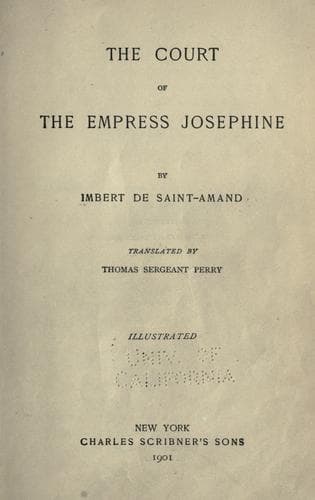
The Court of the Empress JosephineImbert de Saint-Amand
History
The Court of the Empress Josephine
Imbert de Saint-Amand
Josephine, Empress, consort of Napoleon I, Emperor of the French, 1763-1814
Nevertheless she had to obey. June 15, 1806, Louis started from Saint Leu
to go to his kingdom. He was accompanied by his wife and his two sons, the
elder, Charles Napoleon, who died in Holland the 5th of the next May, and
the other, Louis Napoleon, who died at Forte, in 1831, in the insurrection
of the States of the Church against the Pope. His third son, later
Napoleon III., was born in 1808. The new King entered The Hague June 23,
1806. He countermanded a body of French troops which the Emperor had
designed for his escort at his entrance into the capital, being unwilling
to appear before his subjects as a sovereign imposed upon them by actual
force. "You may be sure," he said to them, "that from the moment I set
foot on the soil of this kingdom, I became a Dutchman." The same day
General Dupont Chaumont, French Minister at The Hague, wrote to Prince
Talleyrand: "To-day, June 23, His Majesty made his formal entrance into
his capital. He went to the Assembly where he received the oath of the
representatives of the people and made a speech which was much applauded.
The French camp obtained permission from the Governor of the Palace to
surprise Their Majesties by fireworks and military music. These
festivities naturally put a stop to all business, except for His Majesty,
who finds time to examine and decide the most urgent matters, the ease
with which he works greatly surprising a nation unaccustomed to such
activity. Already the King and Queen are spoken of most enthusiastically
by those who have had the honor to be presented to Their Majesties. The
satisfaction will be general, when many shall have had the opportunity to
approach the throne."
In spite of the optimisms of this despatch, the new King was to have an
unhappy reign. His loyal and upright intentions were to be shattered
against the inflexible will of his formidable brother. Louis was a just
man and sincerely devoted to his people. He was called, and is still
called, "the good King Louis": but the Emperor, who ironically reproached
him with trying to win the affection of shopkeepers, was to write to him
in 1807: "A monarch who is called a good king, is a king that's ruined."
As for Queen Hortense, more and more tormented by her husband's
suspicions, with her health impaired by the moist climate, and her ever-
growing melancholy, she was to feel like a condemned exile in her kingdom.
No woman ever gave a complete lie to the expression, "As happy as a
queen."
XX.
THE EMPRESS AT MAYENCE.
Public-domain text, read in full here on John Shaqi.
Reviews
Reviews
No reviews yet
Be the first to share your thoughts on this work.
Elsewhere in the archive
Join the Discussion
Join the discussion
Sign in to leave a comment or review.
Sign InorCreate an account