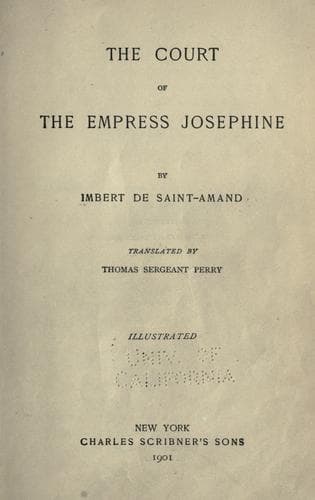
The Court of the Empress JosephineImbert de Saint-Amand
History
The Court of the Empress Josephine
Imbert de Saint-Amand
Josephine, Empress, consort of Napoleon I, Emperor of the French, 1763-1814
Napoleon was not modest in his triumph. He pursued with sarcasms the
nobility of Prussia and Queen Louise who had warmly counselled war. This
fair sovereign, the mother of the late Emperor William, was then thirty
years old; she was the daughter of a Duke of Mecklenburg-Strelitz and of a
Princess of Hesse-Darmstadt. She was a most thorough German, hated France,
and especially the French Revolution. She was a fearless horsewoman, and
had been seen facing great dangers at the battle of Jena. When she rode
before her troops in her helmet of polished steel, shaded by a plume, in
her glittering golden cuirass, her tunic of silver stuff, her red boots
with gold spurs, she resembled Tasso's heroines. The soldiers burst into
cries of enthusiasm, as they saw their warlike Queen; before her were
bowed the flags she had embroidered with her own hands, and the old, torn,
and battle-stained standards of Frederick the Great. After the battle she
was obliged to take flight, at full gallop, to avoid being captured by the
French hussars.
In his bulletins the Emperor had made the serious blunder of speaking of
Queen Louise in a manner wanting in proper respect for a woman, and
especially for a woman in misfortune. Josephine, who was full of tact, was
much pained by this lack of generosity, and reproached her husband for it.
Napoleon sought to excuse himself, writing, November 6: "I have received
your letter in which you seem pained by the evil I say of women. It is
true that I hate, more than anything, intriguing women. I am used to
kindly, gentle, conciliating women; those are the ones I love. If they
have spoiled me, it is not my fault, but yours. Now I will show you that I
have been very good for one who has shown herself sensible and kind,
Madame Hatzfeld. When I showed her her husband's letter, bursting into
tears, she said to me with, great emotion, and simplicity: 'It is
certainly his hand-writing!' As she read it, her accent touched my heart
and gave me real distress, I said to her: 'Well, Madame, throw that letter
into the fire, I shall not be strong enough to punish your husband,' She
burned the letter and seemed to be very happy, Her husband has ever since
been very calm; two hours more, and he would have been a ruined man. You
see then that I love kind, simple, gentle women; but it's because they are
like you. Good by, my dear, I am well."
Public-domain text, read in full here on John Shaqi.
Reviews
Reviews
No reviews yet
Be the first to share your thoughts on this work.
Elsewhere in the archive
Join the Discussion
Join the discussion
Sign in to leave a comment or review.
Sign InorCreate an account