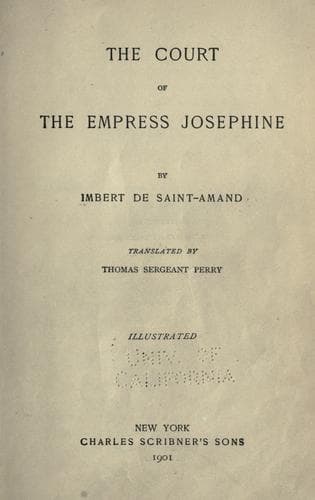
The Court of the Empress JosephineImbert de Saint-Amand
History
The Court of the Empress Josephine
Imbert de Saint-Amand
Josephine, Empress, consort of Napoleon I, Emperor of the French, 1763-1814
The kingdom of Prussia was conquered, but the war was not over, After
fighting the Prussians he had to fight the Russians; the war in Poland was
beginning. Napoleon wrote to the King of Prussia: "Your Majesty has
announced to me that you have thrown yourself into the arms of the
Russians. The future will decide whether this is the best and wisest
choice. You have taken the dice-box and thrown the dice; the dice will
decide it." At Paris, in spite of the splendors of the Imperial glory,
there existed a vague uneasiness. Peace had been expected after Jena, and
some apprehension was felt about the renewal of the struggle in the
northern steppes. Madame de Remusat wrote, November 9, to her husband, who
was at Mayence with the Empress, "There is something in the Emperor's
career which confounds ordinary calculations, and, so to speak, goes
beyond them. It is most impressive, and, I might say, alarming, and yet he
seems so far above customary conditions that there is no need of fear
about the points to which he exposes himself, and still less, draw the
line at which he shall stop. But I shudder to think how far he is from us
at this moment. May God be with him, I am ever praying, and preserve him!
While this great part of the French nation which is under his orders, is
marching to great victories, we are vegetating here in complete dulness.
There is very little society, and no houses are open."
Josephine was very anxious to join her husband who held it before her as a
possibility, but never permitted it. He had written to her, November 16:
"I am glad to see that my views please you. You were wrong to think I was
flattering; I spoke of you as you seem to me. I am sorry to think that you
are bored at Mayence. If the journey was not so long you might come here,
for the enemy has left, and is beyond the Vistula; that is to say, one
hundred and twenty leagues from here. I will await your decision. I shall
be glad to see M. Napoleon. Good by, my dear. Ever yours." And November
22: "Be satisfied and happy in my friendship, in all I feel for you. In a
few days I shall decide to summon you or to send you to Paris. Good by.
You may go now, if you wish, to Darmstadt and Frankfort; that will amuse
you. Much love to Hortense." After signing the decree establishing the
continental blockade, Napoleon had left Berlin November 25. The next day
he again held before Josephine the prospect of a speedy meeting. "I am at
Custrin," he said in his letter, "to make some reconnoissances; I shall
see you in two days if you are to come. You can hold yourself in
readiness. I shall be glad to have the Queen of Holland come too. The
Grand Duchess of Baden must write to her husband about coming. It is two
o'clock in the morning; I have just got up. That is the way at war. Much
love to you and every one." A letter from Meseritz, March 27, was still
more explicit: "I am going to make a trip through Poland; this is the most
important city here.
Public-domain text, read in full here on John Shaqi.
Reviews
Reviews
No reviews yet
Be the first to share your thoughts on this work.
Elsewhere in the archive
Join the Discussion
Join the discussion
Sign in to leave a comment or review.
Sign InorCreate an account