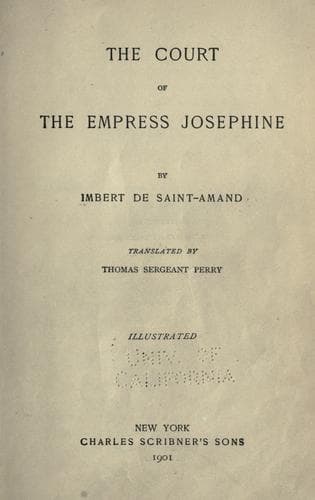
The Court of the Empress JosephineImbert de Saint-Amand
History
The Court of the Empress Josephine
Imbert de Saint-Amand
Josephine, Empress, consort of Napoleon I, Emperor of the French, 1763-1814
Constant says that he found his master the next morning very busy. The
Emperor had written many letters the previous evening to the Polish lady,
who had made no reply. His pride was wounded by a resistance to which he
had not been accustomed since he had become great. At last, however, he
had written so many, and such ardent and touching letters, that she
consented to visit him one evening between ten and eleven. The grand
personage who had tried to make the negotiations, was ordered to go to a
remote spot and receive the lady in a carriage. Napoleon paced the room
while awaiting her, betraying emotion and impatience. "At last Madame V.
arrived," says Constant, whose master kept asking him what time it was.
"She was in a most pitiable condition, pale, silent, her eyes full of
tears. As soon as she appeared, I led her to the Emperor's room. She could
scarcely stand and she was trembling as she leaned on my arm. Then I
withdrew with the great personage who had brought her. During her
interview with the Emperor, Madame V. wept and sobbed so that I could
overhear her even at a great distance. At about two in the morning, the
Emperor called me. I went to him and saw Madame V. going away, with her
handkerchief at her eyes, weeping freely. The same personage carried her
away. I thought she would never come back." But, contrary to his
expectations, Madame V. came back two or three days later at about the
same hour; she seemed calmer, her eyes were less red, her face not so
pale, and she continued her visits during the Emperor's stay. Evidently
Josephine had good grounds for jealousy.
Napoleon interrupted these distractions by going forth to fight the battle
of Eylau, one of the bloodiest and most obstinate combats known to
history. He described it in two letters to the Empress, written in the
same day. This is the first:--
"Eylau, February 9, 1803, 3 A.M. MY DEAR: We had a great battle yesterday.
I was victorious, but our loss was heavy; that of the enemy, which was
even greater, is no consolation for me. I write you these few lines
myself, though I am very tired, to tell you that I am well and love you.
Ever yours."
This is the second:--
"Eylau, February 9, 6 P.M. I write a word lest you should be anxious. The
evening lost the battle; forty cannon, ten flags, twelve thousand
prisoners, suffering horribly. I lost sixteen hundred killed and three to
four thousand wounded. Your cousin, Tascher, is unhurt. I have placed him
on my staff as artillery officer. Corbineau was killed by a shell. I was
exceedingly attached to him; he was an excellent officer, and I am deeply
distressed. My Horse Guard covered itself with glory. D'Allemagne is
dangerously wounded. Good by, my dear."
Public-domain text, read in full here on John Shaqi.
Reviews
Reviews
No reviews yet
Be the first to share your thoughts on this work.
Elsewhere in the archive
Join the Discussion
Join the discussion
Sign in to leave a comment or review.
Sign InorCreate an account