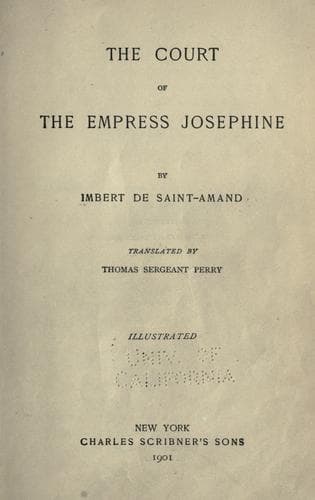
The Court of the Empress JosephineImbert de Saint-Amand
History
The Court of the Empress Josephine
Imbert de Saint-Amand
Josephine, Empress, consort of Napoleon I, Emperor of the French, 1763-1814
The Emperor did not tell everything to Josephine; he said nothing about
the terrible vicissitudes of the battle, a victory scarcely to be
distinguished from a defeat; he kept silence about the cruel sufferings of
his army which, without having eaten, had fought amid blinding snow
beneath a leaden sky; he said no word about the regiments destroyed, one
in particular, from colonel to drummers, all killed or wounded; he did not
mention his own danger in the cemetery on the hill, where he had stood
surrounded by his Guard, his last resource, anxiously watching the fight
from its beginning, slashing the snow with his whip, and exclaiming at the
approach of the Russian Grenadiers as they advanced towards him, "What
audacity!" He did not say that after the terrible and fruitless bloodshed,
which both armies claimed as a victory, he had been obliged to withdraw,
and that Bennigsen had taken possession of the hotly disputed battle-
field. He did not say what he was about to say in his bulletins: "Imagine,
on a space a league square, nine or ten thousand corpses; four or five
thousand dead horses; lines of Russian knapsacks; fragments of guns and
sabres: the earth covered with bullets, shells, supplies; twenty-four
cannon, surrounded by their artillery-men, slain just as they were trying
to take their guns away; and all that in plainest relief on the stretch of
snow." He did not quote the words he uttered in the biting frost, in face
of thousands of dead and dying, when the gloomy day was sinking into a
night of anguish: "This sight is one to fill rulers with a love of peace
and a horror of war." No; the Emperor did not tell her everything.
In another letter, dated Eylau, February 11, 8 A.M., the Emperor tried to
reassure the Empress: "I send you a line: you must have been very anxious,
I fought the enemy on a memorable day which cost me many brave men. The
bad weather drove me into winter quarters. Do not distress yourself, I beg
of you; it will all be over soon, and my delight at seeing you once more
will soon make me forget my fatigue. Besides, I have never been better.
Little Tascher, of the fourth of the line, did well; and he had a hard
experience. I have given him a place near me, in the artillery; so his
troubles are over. The young man interests me. Good by, my dear; a
thousand kisses."
Public-domain text, read in full here on John Shaqi.
Reviews
Reviews
No reviews yet
Be the first to share your thoughts on this work.
Elsewhere in the archive
Join the Discussion
Join the discussion
Sign in to leave a comment or review.
Sign InorCreate an account