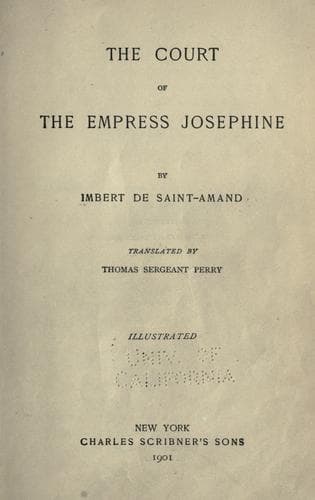
The Court of the Empress JosephineImbert de Saint-Amand
History
The Court of the Empress Josephine
Imbert de Saint-Amand
Josephine, Empress, consort of Napoleon I, Emperor of the French, 1763-1814
Napoleon became tired of the monotonous and excessively disagreeable stay
at Osterode, where he could not receive the Polish lady to whom he became
continually more and more attached. Early in April he installed himself at
Finkenstein, in a pretty castle belonging to a Prussian crown official,
and there he was very comfortably quartered with his staff and military
household. It was from thence that he wrote, April 2, the following short
letter to Josephine: "My dear, I send you a line. I have just moved my
headquarters to a very pretty castle, like that of Bessieres, where I have
a number of open fireplaces, which is very pleasant for me, as I get up
often in the night; I like to see the fire. My health is perfect, the
weather is fine, but still cold. The thermometer is but a few degrees from
freezing. Good by, my dear. Ever yours." As soon as Napoleon was settled
in this castle his first thought was to send for the Polish lady, for whom
he had fitted up an apartment near his own. She left at Warsaw her old
husband, who never consented to see her again, and spent three weeks with
the Emperor. "They took all their meals together," says Constant. "I was
the only one in attendance, so I was able to overhear their talk which was
always amiable, lively, and eager on the part of the Emperor, always
tender, affectionate and melancholy on the part of Madame V. When His
Majesty was away Madame V. spent all her time in reading or looking
through the blinds of the Emperor's room at the parades and drills going
on in the courtyard of the castle, which he often directed in person."
Constant, who felt bound to admire his master's choice, adds with some
feeling: "The Emperor appeared, to appreciate perfectly the interesting
qualities of this angelic woman, whose gentle, unselfish character left on
me an impression that can never fade... Her life, like her nature, was
calm and uniform. Her character fascinated the Emperor and bound him down
to her." This loving idyl, a sort of interlude in the tragedy of war, may
have suited Constant's taste, but it was hardly of a nature to please
Josephine, who, like most jealous people, knew almost always what she
wanted to know, and from the Tuileries found means to watch what was going
on in this distant castle.
Napoleon's letters to Josephine during the reign of Madame V. were shorter
and more stupid than usual. They were merely a few lines on the weather,
the Emperor's health, or his desire to hear that his wife was "cheerful
and happy." But, alas! cheerfulness and happiness were not for her! Too
astute to be hoodwinked, she understood that her husband still had a
friendly feeling for her but that his love was dead. In the eyes of a
jealous woman, friendship is a slight thing. What does she care for the
esteem and attentions of a friend who was once her lover? To all the good
services of friendship she would a thousand times prefer the anger, fury,
violence, of love.
XXII.
THE DEATH OF THE YOUNG NAPOLEON.
Public-domain text, read in full here on John Shaqi.
Reviews
Reviews
No reviews yet
Be the first to share your thoughts on this work.
Elsewhere in the archive
Join the Discussion
Join the discussion
Sign in to leave a comment or review.
Sign InorCreate an account