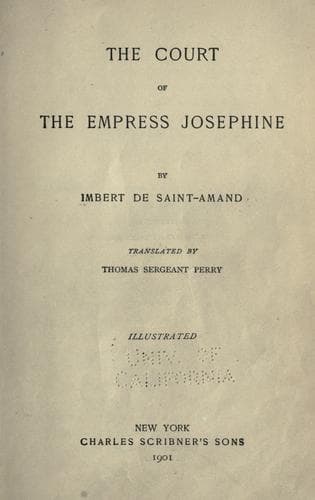
The Court of the Empress JosephineImbert de Saint-Amand
History
The Court of the Empress Josephine
Imbert de Saint-Amand
Josephine, Empress, consort of Napoleon I, Emperor of the French, 1763-1814
Queen Hortense was no happier in her Holland palaces than was the Empress
in the Tuileries. She had to endure all the grief, deception, and misery
of an ill-assorted marriage. The incompatibility of disposition which
existed between her husband and herself from the first days of their
married life, made itself continually more felt. King Louis blamed his
wife not merely for her faults, but also for her good qualities. He was
sometimes annoyed because she was gracious, amiable, charming; and the
general sympathy she aroused in Holland, as in France, excited the fears
of this irritable and sullen husband. Hortense looked upon herself as a
victim. She had a lively imagination, and exaggerated her grief to
herself, suffering more keenly on account of her excitement, which was
often very great. One day she said to Madame de Remusat, her intimate and
admiring friend, that her life was so painful and apparently so hopeless
that when she was at one of her villas near the sea, and looked out on the
ocean where were the English fleets blockading her ports, she wished that
chance might bring a ship to where she was, and she might be carried off a
prisoner.
The conjugal infelicities of Louis and his wife attracted the attention of
the Emperor, who kept as strict a guard over his family as over his
Empire, and was as prompt to exercise control in private, as in political
matters. He wanted his brother to obey him, both as King and husband, and
in his discontent at seeing his orders disobeyed, he wrote to him, from
the depths of Poland, April 4, 1807, this reproachful letter, which is a
real reprimand: "Your quarrels with the Queen have become public. Show,
then, in private life some of that paternal and effeminate character which
you display in matters of government, and in business the same rigor you
exercise in your household. You treat a young woman as we treat a
regiment.... You have an excellent and most virtuous wife and you make her
unhappy. Let her dance as much as she pleases; she is young. My wife is
forty; I wrote to her from the battle-field to go to a ball. And you want
a young woman of twenty, who sees her life flitting, and has every
illusion, to live in a cloister, or to be always washing her baby like a
nurse. You are too much _you_ in your household, and not enough in your
administration. I should not say all this to you except for the interest I
have for you. Make the mother of your children happy; you have one way to
do this: that is, by showing her esteem and confidence. Unfortunately your
wife is too virtuous; if you had married a coquette she would lead you by
the end of your nose. But you have a proud wife who is afflicted and
distressed by the mere thought that you may have a bad opinion of her. You
ought to have married any one of a number of women whom I know in Paris;
she would have had no difficulty in getting ahead of you and would have
kept you at her feet. It is not my fault, I have often told your wife so."
Public-domain text, read in full here on John Shaqi.
Reviews
Reviews
No reviews yet
Be the first to share your thoughts on this work.
Elsewhere in the archive
Join the Discussion
Join the discussion
Sign in to leave a comment or review.
Sign InorCreate an account