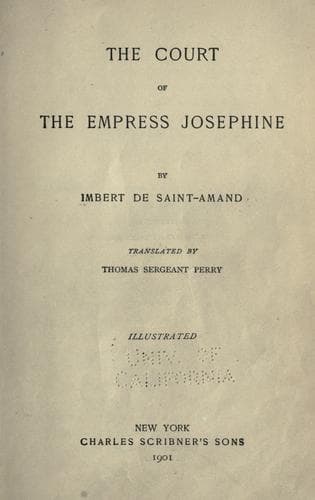
The Court of the Empress JosephineImbert de Saint-Amand
History
The Court of the Empress Josephine
Imbert de Saint-Amand
Josephine, Empress, consort of Napoleon I, Emperor of the French, 1763-1814
Napoleon, who forbade his wife and daughter-in-law to be gloomy,--an order
more easily given than obeyed,--thought their mourning excessive. His
expressions of sympathy were very singular. He wrote from Finkenstein to
Queen Hortense, May 20, 1807:--
"MY DAUGHTER: Everything I hear from The Hague tells me you are not
reasonable. However legitimate your grief, it should have some bounds. Do
not ruin your health; seek some distractions, and remember that life is so
full of dangers and evils that death is not the worst thing that can
befall one." In his letter of May 24 to the Empress, the Emperor spoke of
the unhappy Queen with a severity that amounted to brutality: "Hortense is
unreasonable and does not deserve to be loved since she does not love any
one but her children. Try to calm her and do not make trouble for me. For
every hopeless evil, consolation must be found." He wrote to her again,
May 26: "I have your letter of the 16th. I am glad Hortense has gone to
Laeken. I am sorry to hear what you say about the sort of stupor she is
in. She might show courage and self-control. I can't understand why she
should be sent to the baths; she could find more distractions in Paris.
Control yourself; be cheerful, and keep well. My health is excellent. Good
by. I stare your sufferings, and am sorry not to be with you."
In her bitter grief Hortense lacked courage to write to the Emperor, who
was annoyed by her silence. "My dear," he wrote to Josephine, June 2, "I
hear that you have arrived at Malmaison. I have no letters from you. I am
vexed with Hortense; she has not written me a word. All you tell me about
her distresses me. Why could you not distract her a little? You are always
in tears! I hope you will show some self-control, that I may not find you
sad. I have been for two days at Dantzic; the weather is fine; I am well.
I think of you more than you think of an absent man. Good by; much love.
Forward to Hortense this letter." This is the severe epistle which
Josephine was bidden to send to Hortense:--
"June 2. MY DAUGHTER: You have not written me a word in your great and
natural grief. You have forgotten everything, as if you had not still
losses to endure. I hear that you love nothing, are indifferent to
everything; this is plain from your silence. That is not right, Hortense.
It is not what you promised us. Your son was everything for you? Are your
mother and I nothing? Had I been at Malmaison I should have shared your
sorrow, but I should have wanted you to listen to your best friends. Good
by, my daughter; be cheerful; you must be resigned. My wife is much
distressed at your condition; do not give her further pain. Your
affectionate father."
It is easily seen that such letters were ill adapted to allay the anguish
of an inconsolable mother mourning for her child.
Public-domain text, read in full here on John Shaqi.
Reviews
Reviews
No reviews yet
Be the first to share your thoughts on this work.
Elsewhere in the archive
Join the Discussion
Join the discussion
Sign in to leave a comment or review.
Sign InorCreate an account