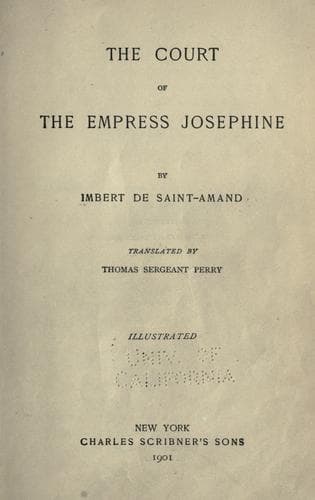
The Court of the Empress JosephineImbert de Saint-Amand
History
The Court of the Empress Josephine
Imbert de Saint-Amand
Josephine, Empress, consort of Napoleon I, Emperor of the French, 1763-1814
Josephine's letters to her daughter showed very different feelings. The
kind Empress did her best to persuade her that the Emperor sympathized
with her grief. She wrote from Saint Cloud, June 4: "Your letter, my dear
Hortense, gives me much consolation, and what I hear from your ladies
about your health makes me easier. The Emperor was much distressed, in
every letter he tries to give me courage, but I know that this unhappy
event was a great blow to him. The King arrived at Saint Len last evening;
he has sent me word that he meant to call on me to-day, and he must leave
the boy here during his absence. You know how much I love the child, and
how careful I shall be of him. I want the King to take the same route as
you; it will be a consolation for you both to meet. All his letters since
you left are full of love for you. He has too tender a heart not to be
touched. Good by, my dear daughter; take care of your health; mine will
improve only when I don't have to suffer for those I love." This letter
shows all the kindness and gentleness of Josephine's character. She was
conciliating and benevolent, and did her best to smooth over Napoleon's
blame and to reconcile Hortense with her husband. She wrote again from
Saint Cloud, June 11: "Your boy is very well, and amuses me a great deal;
he is so gentle; I think he has all the ways of the poor boy we mourn."
Josephine understood consolation better than the Emperor.
What could be more touching, more maternal, than this letter from the
Empress? "Your letter moved me deeply; I see your grief is ever fresh and
I perceive this better by my own sufferings. We have lost what was most
worthy to be loved; my tears flow as they did the first day. Those regrets
are too natural to be repressed by reason, although it should moderate
them. You are not alone in the world. You have left a husband, an
interesting child, and you are too tender for that to be strange and
indifferent to you. Think of us, my dear daughter, and let this calm your
natural sorrow. I rely on your love for me and on your reasonableness. I
hope that the trip and the waters will do you good. Your son is very well,
and is charming. My health is a little better, but you know it depends on
yours. Good by. Many kisses."
The character of this loving mother and grandmother manifests itself in
every one of her letters. Her style was simple and affectionate, like
herself. Her letters, full of the gentlest, best, and most touching
feeling, might make one say, "The style is the woman."
Public-domain text, read in full here on John Shaqi.
Reviews
Reviews
No reviews yet
Be the first to share your thoughts on this work.
Elsewhere in the archive
Join the Discussion
Join the discussion
Sign in to leave a comment or review.
Sign InorCreate an account