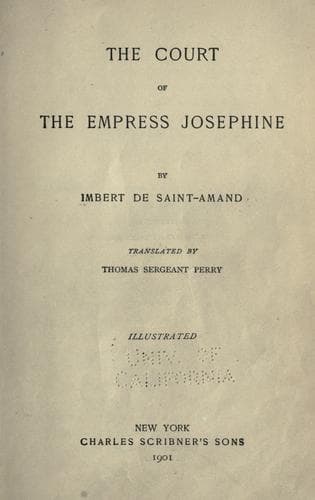
The Court of the Empress JosephineImbert de Saint-Amand
History
The Court of the Empress Josephine
Imbert de Saint-Amand
Josephine, Empress, consort of Napoleon I, Emperor of the French, 1763-1814
Under the second Empire, what were called the _series_ of Compiegne and of
Fontainebleau were much less ceremonious than under the first. All the
guests of Napoleon III. breakfasted and dined at his table,--in the
morning in frock-coat, in the evening in black coat and knee breeches; no
uniforms were to be seen. Women appeared at breakfast in morning dress;
they wore no especial dress at the hunt. Before dinner the Empress used to
receive a few specially invited guests to drink tea. All day the Emperor
left the company perfectly free. In the evening there was dancing to the
music of a piano like a hand-organ, of which a chamberlain turned the
handle. The Emperor was treated with great deference, but no one feared
him, because his words were always marked by great affability. Napoleon
I., on the other hand, was perhaps more feared than admired. Those who
were charged with organizing his entertainments were perfectly happy if he
was silent; for he almost never gave a word of praise and often
criticised. It was a conspicuous and rare honor, even for Princes, to dine
with him. There were besides at Fontainebleau, in 1807, several distinct
tables: those of the Princes and Princesses of the Imperial family, who
often gave grand dinners; that of the Grand Marshal of the Palace, with
twenty-five places; that of the Empress's Maid of Honor, with the same
number; and, finally, a last table for all those who had received no
special invitation. The Princesses paid the cost--of installing themselves
there out of their own purses, while under Napoleon III., at
Fontainebleau, or at Compiegne, all the expenses were defrayed by the
Emperor. Under the first Empire only those holding high official position
were invited to the Imperial, residences; under the second, many were
invited who were famous only for their elegance. Under Napoleon I., where
everything was formal, scarcely anything but tragedy was played at the
court; under Napoleon III., lighter plays were often given. The hunts were
very simple under the second Emperor and very magnificent under the first,
In 1807 Napoleon had ordered that women who went to the coursing should
wear a special costume; that of the Empress and of all the ladies of her
household was of amaranthine velvet, embroidered with gold, and a cap with
white feathers; that of the Princesses, blue for the Queen of Holland,
pink for the Princess Murat, lilac for the Princess Borghese, all adorned
with silver embroidery. The Emperor and all his guests wore the same
hunting-dress for coursing: a green coat with gold, buttons and lace,
breeches of white cassimere, Hessian boots without tops; for shooting, a
green coat, with no other ornament than white buttons, on which were
carved hunting emblems. Under the first Empire, etiquette was most rigid;
under the second, it hardly existed. At every moment of day and evening,
Napoleon I. wore a twofold air as commander-in-chief and sovereign;
Napoleon III.
Public-domain text, read in full here on John Shaqi.
Reviews
Reviews
No reviews yet
Be the first to share your thoughts on this work.
Elsewhere in the archive
Join the Discussion
Join the discussion
Sign in to leave a comment or review.
Sign InorCreate an account