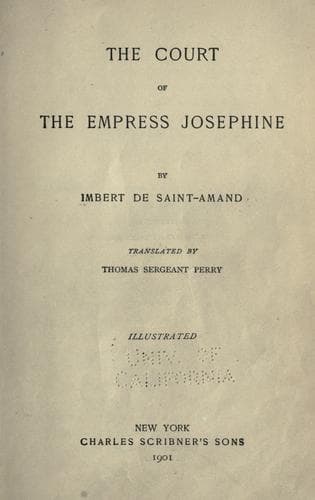
The Court of the Empress JosephineImbert de Saint-Amand
History
The Court of the Empress Josephine
Imbert de Saint-Amand
Josephine, Empress, consort of Napoleon I, Emperor of the French, 1763-1814
was like a man of the world receiving his friends in his own
castle.
From September 21 to November 15, 1807, the great general had commanded
that there should be amusement in the Palace of Fontainebleau. Pleasure
was ordered, but it does not come at call. The Emperor, accustomed to have
his every wish obeyed, was surprised to see that not every face was
radiant. "Strange," he said, "I have gathered a good many people here at
Fontainebleau; I want them to amuse themselves, I have arranged their
pleasures, yet every one seems tired and sad." The Italian songs, even
when sung by the best singers, in costume and with all the scenery,
produced but a feeble impression. The tragedies seemed to induce slumber.
The little balls, or, more exactly, the little hops in the apartment of
the Maid of Honor, Madame de la Rochefoucauld, were very dull. Sometimes
little games were played there; they gave a flash of gaiety, but as soon
as the Emperor appeared, every one assumed a serious, composed air. Might
one not say once more what La Bruyere said when speaking of the court of
Louis XIV.: "Who would believe that this eagerness for shows, that meals,
hunts, ballets, tilting-matches, crowned so many anxieties, pains, and
diverse interests, so many fears and hopes, so many lively passions, and
serious affairs?" A palace is not built for ease. All its formalities hang
heavy on every guest; the whole of every day is spent in playing a part.
Amid all these empty pleasures and hollow joys there was no lack of
sorrow. It was there that the wretched Queen Hortense, spitting blood,
mourning the past and dreading the future, said to Napoleon: "My
reputation is tainted, my health ruined, I expect no more happiness in
life; banish me from your court; if you wish, lock me up in a convent, I
desire neither throne nor fortune. Give peace to my mother, glory to
Eugene, who deserves it, but let me live a calm and solitary life." She
had been happier as an unknown schoolgirl at Madame Campan's, just as her
mother, the Empress of the French and the Queen of Italy, must have often
sighed for the island of Martinique, where she would have preferred the
splash of the waves to the courtiers' murmur of obsequious flattery.
Napoleon, himself, at the height of human glory, had lost the peace of
heart which he enjoyed in his boyhood, and never found again.
The Empress Josephine naturally held the highest place in this brilliant
court of Fontainebleau, and was the object of untiring homage; few,
however, suspected the anxieties that tormented her, so calm happy did she
appear, with a kind word and a gracious smile for every one.
Public-domain text, read in full here on John Shaqi.
Reviews
Reviews
No reviews yet
Be the first to share your thoughts on this work.
Elsewhere in the archive
Join the Discussion
Join the discussion
Sign in to leave a comment or review.
Sign InorCreate an account