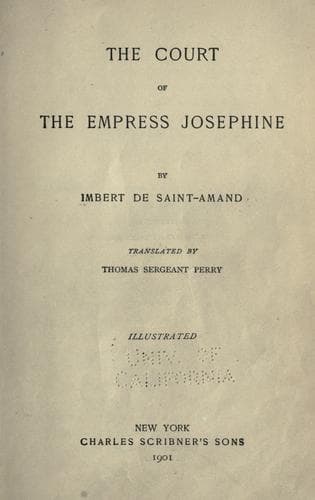
The Court of the Empress JosephineImbert de Saint-Amand
History
The Court of the Empress Josephine
Imbert de Saint-Amand
Josephine, Empress, consort of Napoleon I, Emperor of the French, 1763-1814
"Is it not clear that Fouche was sent by the Emperor and that my fate is
settled? Alas! To leave the throne is nothing to me. Who knows better than
I do how many tears I have shed there? But to lose at the same time the
man to whom I have given my best love, that sacrifice is beyond my
strength."
But to return to Prince Metternich's despatch: "Many days passed without
incident, when suddenly the Emperor began to share again the Empress's
apartment and took a favorable moment to ask why she had been so sad for
some days. The Empress then told him of her interview with Fouche. The
Emperor confirmed his statement that he had never given him any such
orders. He added that she ought to know him well enough to be sure that he
had no need of any go-between to manage matters with her, and made her
promise to report to him anything further she might hear about the
matter." Josephine was not at all comforted. Napoleon's explanation was
very embarrassed, and who could think that so crafty and ambitious a man
as Fouche could assume the responsibility of such a negotiation if he
supposed that thereby he exposed himself to his master's wrath?
The Minister of Police did not confine himself to mere spoken words. A few
days after his interview with the Empress, he wrote to her a long letter
on large paper, in which he set forth all the arguments he had already
brought forward, to urge upon her the spontaneous sacrifice which would be
the more meritorious, the more painful it was. Josephine, who received
this letter in the evening, summoned M. de Remusat at midnight to show it
to him. "What shall I do," she asked, "to ward off this storm?" "Madame,"
replied the First Chamberlain, "my advice is to go this very moment to the
Emperor, if he has not gone to bed, or else the very first thing to-morrow
morning. Remember, you must seem to have consulted no one. Make him read
this letter; watch him as closely as you can; but, whatever happens, show
that you hate these roundabout methods, and tell him again that you will
never listen to anything but a direct order from him."
The Empress did as he said, Napoleon, to use a common expression, was
"cornered." He pretended to be much surprised, and very angry; promised
"to comb Fouche's head," and even added that if she desired he would take
away his portfolio; and to calm her he went so far as to write to the
Minister of Police this letter, dated Fontainebleau, November 5, 1807:--
"MONSIEUR FOUCHE: In the last fortnight I have heard of your foolish
actions; it is time for you to put an end to them, and to stop
interfering, directly or indirectly, in a matter which in no way concerns
you; that is my wish."
Public-domain text, read in full here on John Shaqi.
Reviews
Reviews
No reviews yet
Be the first to share your thoughts on this work.
Elsewhere in the archive
Join the Discussion
Join the discussion
Sign in to leave a comment or review.
Sign InorCreate an account