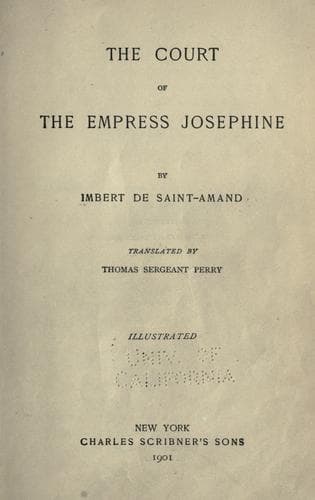
The Court of the Empress JosephineImbert de Saint-Amand
History
The Court of the Empress Josephine
Imbert de Saint-Amand
Josephine, Empress, consort of Napoleon I, Emperor of the French, 1763-1814
M. de Metternich, the Austrian Ambassador who was then at Fontainebleau,
took pains to ascertain the causes of her secret sorrow, and sent the
details to his government. He wrote to von Stadion: "In many of my
previous reports I have had the honor of speaking to Your Excellency about
the long current rumors regarding the approaching divorce of the Emperor.
After circulating vaguely in the last two months, they have become the
subject of general and public discussion. It is true of these rumors, as
of all not stamped out at their birth, that they rest on some foundation
of truth, or they would be promptly silenced, if they were not directly
tolerated." Then the clear-sighted ambassador reported in the same
despatch what he had learned, thanks to his relations with persons to whom
the Empress had made revelations: "Since his return from the army, the
Emperor's bearing towards his wife has been cold and embarrassed. He no
longer lives in the same apartment with her, and many of his daily habits
have undergone a change. Rumors of the Empress's divorce began at that
moment to assume a more serious form; when they reached her ears she
simply waited for some direct information, without letting the Emperor see
the slightest anxiety."
Josephine was sorely stricken, and her sufferings were all the more
intense because she had to hide them from every one, especially from her
husband, and they made a marked contrast, by the irony of fate, with the
pleasures and amusements that surrounded her. She was too clear-sighted
and intelligent to proceed to question the Emperor. She feared light and
dreaded the truth. She hesitated before the abyss that awaited her, and
shuddered before the Emperor's glance. She suffered on the throne, as if
it were an instrument of torture. It was then that Fouche took some steps
which doubled her anguish. The incident is thus recounted, by Prince
Metternich in the despatch already cited: "One day the Minister of Police
visited her at Fontainebleau. and after a short preamble, told her that
the public good, and, above all, the strengthening of the existing dynasty
requiring that the Emperor should have children, she ought to ask the
Senate to join with her in demanding of the Emperor a sacrifice most
painful to his heart. The Empress, who was prepared for the question,
asked Fouche, with great coolness, if he took this step by the Emperors
orders. 'No,' he replied: 'I speak to Your Majesty as a minister charged
with a general supervision, as a private citizen, as a subject devoted to
his country's glory,' 'In that case I have nothing to say to you,'
interrupted the Empress; 'I regard my union with the Emperor as written in
the book of Fate, I shall never discuss the matter with any one but him,
and never will do anything but what he orders,'" Josephine, when she
mentioned this conversation to her confidant, M. de Lavalette, who had
married a Mademoiselle de Beauharnais, said to him in great perplexity;
Public-domain text, read in full here on John Shaqi.
Reviews
Reviews
No reviews yet
Be the first to share your thoughts on this work.
Elsewhere in the archive
Join the Discussion
Join the discussion
Sign in to leave a comment or review.
Sign InorCreate an account