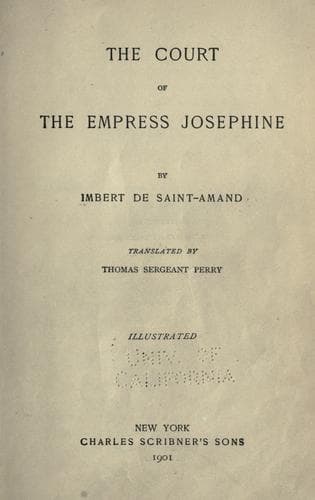
The Court of the Empress JosephineImbert de Saint-Amand
History
The Court of the Empress Josephine
Imbert de Saint-Amand
Josephine, Empress, consort of Napoleon I, Emperor of the French, 1763-1814
This marvellously picturesque palace of Fontainebleau is full of
interesting reminiscences, but of all the figures it recalls, no figure is
more impressive than that of Napoleon. There is much gorgeous furniture in
the palace of various sorts, in the style of the renaissance, of Louis
XIV., Louis XV., and Louis XVI.; but no piece attracts more attention than
the plain mahogany table on which Napoleon signed his abdication. Then how
impressive is the bedroom where he spent terrible nights, unable to sleep,
and at last seeking in suicide a cure for his despair! Consider the
contrast between 1807 and 1814! Meanwhile there had been changes of face,
many apostasies. "Ah! Caulaincourt, mankind, mankind!" exclaimed the
deserted Emperor. Every one left him, promising him a speedy return, but
no one thought of it. Fontainebleau became a desert. If the sound of
wheels was heard, it was never of carriages arriving, but only of
carriages going away. It was at Fontainebleau that Napoleon's pride
triumphed, and there that his pride suffered its cruelest humiliations.
What anguish he endured, this man of destiny, in that room where he wrote:
"To finish my career by signing a treaty in which I have not been able to
stipulate a single general interest, nor even one moral interest, such as
the preservation of our colonies, or the maintenance of the Legion of
Honor! To sign a treaty by which money is given to me!" What anguish tore
his mind and body when, having taken too small a dose of poison, he said
between his spasms: "How hard it is to die, and it is so easy on the
battle-field! Why didn't I die at Arcis-sur-Aube!" Did he then recall the
splendor of his return from Jena, from Friedland, from Tilsitt? Did he
remember the crowd of courtiers who resembled priests whose God he was?
The only courtiers left were those to whom he had given neither money nor
honors, the old soldiers of his guard, with, their gray mustaches, who
could not restrain their sobs and tears when, in the Court of the White
Horse, he bade them farewell, saying, "I should like to embrace you in my
arms, but let me embrace this flag which represents you."
XXVI.
THE END OF THE YEAR, 1807.
Public-domain text, read in full here on John Shaqi.
Reviews
Reviews
No reviews yet
Be the first to share your thoughts on this work.
Elsewhere in the archive
Join the Discussion
Join the discussion
Sign in to leave a comment or review.
Sign InorCreate an account