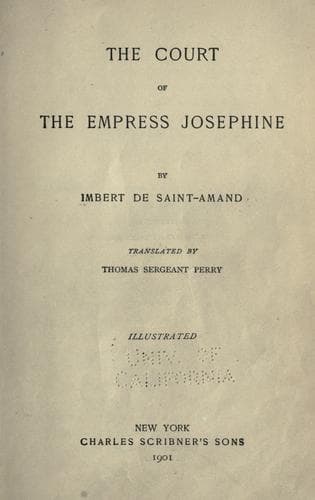
The Court of the Empress JosephineImbert de Saint-Amand
History
The Court of the Empress Josephine
Imbert de Saint-Amand
Josephine, Empress, consort of Napoleon I, Emperor of the French, 1763-1814
While the court was still at Fontainebleau, the Empress received a piece
of news, which had been kept back from her for some days, and which added
materially to her sorrows. Her widowed mother, Madame Tascher de la
Pagerie, whom she had not seen since September, 1790, had died June 2,
1807, at the age of seventy, in her home at Martinique. Josephine, who was
much attached to her mother, had done her best to persuade her to come to
France, where she would have been sure of the warmest welcome. But that
venerable lady had perhaps chosen more wisely in preferring her modest and
quiet home to all the splendor and excitement of an Imperial palace. From
afar she thought of her daughter at the summit of human happiness; near
her, she would often have seen her sad and downcast. By not approaching
the throne which, at a distance, appears like a magic seat, but, to use
the Emperor's expression, is in fact only an armchair covered with velvet,
Napoleon's mother-in-law was spared the sight of much misery, and she
died, as she had lived, in peace.
The Emperor left for Italy November 16. 1807, and this departure was for
Josephine, already so afflicted, another source of anxiety and sadness,
She would gladly have gone with him, and have seen once more Eugene and
her granddaughter, who was named after her; but Napoleon had decided
otherwise. He was no longer unable to live without his wife, and he no
longer thought with La Fontaine that absence was the greatest of evils. He
alleged as reason, the inclemency of the winter, said that he should be
back early in December--in fact, he did not return to the Tuileries till
January 1--and to the Empress's great despair set off without her, leaving
her the prey of the liveliest anxiety, the cruelest fears.
In Italy Napoleon received the same ardent flattery as in France. He
reached Milan November 22, before Prince Eugene had had time to ride out
to meet him. After ovations, reviews, religious ceremonies at the
Cathedral, grand performances at the Scala, he went to Venice. Here he was
received with all the luxury that used to be displayed at the majestic
marriage of the doge and the Adriatic. When he reached Fusina, he entered
a gondola rowed by men in satin coats embroidered with gold. He entered
the grand canal beneath an arch of triumph between a double line of boats
adorned with festoons and garlands. At the Venice theatre he saw a grand
performance representing Olympus, and then was played, amid applause, the
popular air, _Napoleone it grande_. He had with him in Venice his brother
Joseph, King of Naples; his sister, Elisa Bacciochi, Princess of Lucca;
his step-son, Prince Eugene, Viceroy of Italy; the King and Queen of
Bavaria, the father-in-law and mother-in-law of this Prince; Murat, Grand
Duke of Berg, and Berthier, Prince of Neufchatel. He left Venice December
8, dining at Treviso. The 11th he was at Udine, and the 14th at Mantua.
Public-domain text, read in full here on John Shaqi.
Reviews
Reviews
No reviews yet
Be the first to share your thoughts on this work.
Elsewhere in the archive
Join the Discussion
Join the discussion
Sign in to leave a comment or review.
Sign InorCreate an account