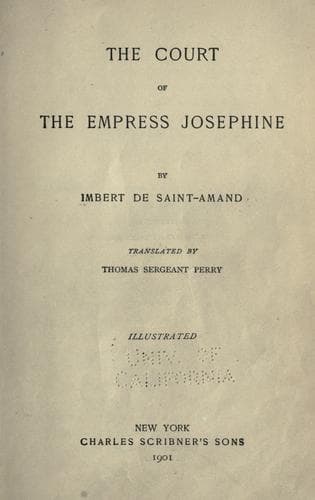
The Court of the Empress JosephineImbert de Saint-Amand
History
The Court of the Empress Josephine
Imbert de Saint-Amand
Josephine, Empress, consort of Napoleon I, Emperor of the French, 1763-1814
The next day there were three performances in every theatre. The pit, the
orchestra, and principal rows of boxes and galleries were reserved for the
Imperial Guard. The opera gave _The Triumph of Trajan_. The Francais gave
_Gaston and Bayard_. "That historical play," said the _Moniteur_, "which
presents so noble and true a picture of French honor, of warlike
victories, of chivalric enthusiasm,--never did this tragedy have
spectators better fitted to appreciate it." In the minor theatres various
plays on the events of the day were given. The performance at the opera
was magnificent; the _Moniteur_ described it with its usual lyrical
enthusiasm: "This picked band of braves, who, in their swift conquests, in
their distant marches, have seen such, diverse climates, visited so many
shores, and in so few months have seen the springs and the mouths of so
many rivers, know also the banks of the Tiber; hence in the scenery they
at ones recognized Rome; in the triumphal march, in the eager throng, in
the vast populace, bursting through the ranks of the Roman soldiers, and
flinging themselves beneath the hoofs of their horses, they saw the
touching picture of the reception they had met the day before. Their
emotion baffles description. The Imperial Guard gazing at Trajan's triumph
was itself an admirable spectacle." The opera was but a series of
ingenious allusions to Napoleon's glory. Trajan was represented as
burning, with his own hand, papers containing the secret of a conspiracy,
recalling Napoleon's throwing into the fire the letters by which, he could
have rained M. Hatzfeld; and when the Roman Emperor appeared in his
chariot, drawn by four white horses, it was not Trajan who was applauded,
but Napoleon.
December 14, at the Military School, Marshal Bessieres, to celebrate the
victories of the Grand Army, and to thank the city of Paris for its
reception of the Imperial Guard, gave a grand entertainment which the
Empress honored with her presence. The Invalides was brilliantly
illuminated and connected with the Military School by a long row of
lights. In the middle of the Champ de Mars was a vast hemisphere, on which
was a pedestal holding a colossal statue of the Emperor, surrounded by
allegoric figures. The trophies set aside for each one of the Grand Army
were marked with the corps number. The Imperial Guard was under arms, and
formed an interesting part of the spectators, and of the spectacle as
well. Bengal fires lit up the warlike scene. The heights across the Seine
were also ablaze with lights. The Empress arrived at the Military School
at about eight in the evening. The entertainment began with a ballet
performed by dancers from the opera. Then there were fireworks. The Champ
de Mars was one sea of flame, and the Imperial Guard fired blank
cartridges for half an hour. Then there was a grand ball with a fine
supper; after which the dances continued till morning.
Public-domain text, read in full here on John Shaqi.
Reviews
Reviews
No reviews yet
Be the first to share your thoughts on this work.
Elsewhere in the archive
Join the Discussion
Join the discussion
Sign in to leave a comment or review.
Sign InorCreate an account