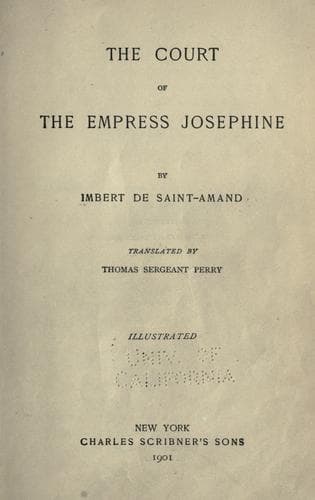
The Court of the Empress JosephineImbert de Saint-Amand
History
The Court of the Empress Josephine
Imbert de Saint-Amand
Josephine, Empress, consort of Napoleon I, Emperor of the French, 1763-1814
This worldly and military entertainment, at which the Empress queen
appeared in all her glory, may be regarded as the crowning point of her
splendors. And here, at the end of 1807, we close this study. We have left
to narrate in a final volume only the last seven years of Josephine's
life. We have already recounted nearly the whole career of this attractive
woman, of this justly famous sovereign. We have described her infancy in
Martinique, in her modest, patriarchal home, where she was born, June 23,
1763. We have admired her as a young girl, loving flowers, music, and
nature, beneath the clear sky of the Antilles, amid banana and orange
trees, tropical flowers, and birds of paradise, where the fortune-telling
negress said to her: "You will be a queen." We have seen her in France,
marrying, December 13, 1779, the young and brilliant Viscount Alexandre de
Beauharnais, by whom she had one son, the future Viceroy of Italy, and one
daughter, the future Queen of Holland. We have seen her going through that
period of illusions, so well called the Golden Age of the Revolution,
receiving in her drawing-room in the rue de l'Universite the flower of the
liberal nobility and leaders of the Constituent Assembly, then suddenly
passing from the Golden to the Iron Age, shuddering at the dangers to
which war, and above all the Terror exposed her husband, the general in
chief of the Army of the Rhine, the leader of the democracy, rewarded for
his patriotism and his devotion to the Republic by the scaffold. She
herself, during her husband's captivity, was imprisoned in the Carmes
April, 1794; for one hundred and eight days of inexpressible anguish and
torment, she occupied in this dungeon the Room of the Swords as it was
called, because the walls still bore traces of the three swords which the
men of September had leaned against them after the massacre of the one
hundred and twenty priests who were in the prison. Beauharnais, the man of
the old regime, who had embraced the new ideas with so much ardor, this
grand lord who got himself treated like a _sans-culotte_ was guillotined
four days before Robespierre, whose death would have saved him. His young
widow left prison, reduced to extreme want, and took refuge with her
father-in-law, at Fontainebleau; then she made her appearance in the
motley society which, first showed itself in the drawing-room of Madame
Tallien, then at the Luxembourg under Barras. Rivalling Madame Tallien and
Madame Recamier in popularity, she smiled through her tears, like
Andromache in Homer. Her means becoming greater, thanks to the support of
men in authority, she bought in the rue Chantereine, afterwards rue de la
Victoire, a little house belonging to Talma, the tragedian. There she
received with her customary courtesy the few survivors of French
aristocracy who said behind well-closed doors: "Let us talk about the old
court; let us take a turn at Versailles."
Public-domain text, read in full here on John Shaqi.
Reviews
Reviews
No reviews yet
Be the first to share your thoughts on this work.
Elsewhere in the archive
Join the Discussion
Join the discussion
Sign in to leave a comment or review.
Sign InorCreate an account