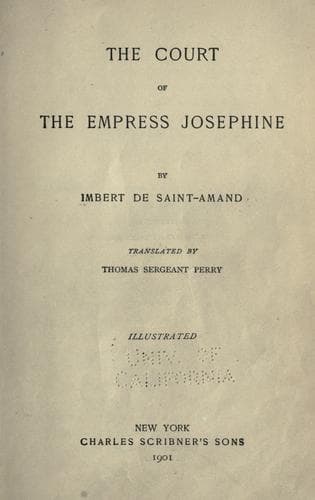
The Court of the Empress JosephineImbert de Saint-Amand
History
The Court of the Empress Josephine
Imbert de Saint-Amand
Josephine, Empress, consort of Napoleon I, Emperor of the French, 1763-1814
Bonaparte left for Egypt, embarking at Toulon, May 19, 1798, after taking
tender leave of Josephine. During her husband's absence, she bought the
estate of Malmaison, an unknown spot which soon became famous. She
skilfully defended Bonaparte's interests with the Directory, and in her
drawing-room met celebrities of every kind. But malicious persons soon
sent to Egypt hostile rumors, and her impetuous husband, wild with jealous
wrath, spoke of nothing but separation and divorce. He reached Paris
unexpectedly, October 16, 1799, and not finding his wife there, started
off to meet her on a different road from hers, wild with jealousy. His
brothers, Josephine's enemies, deceived him, and at first he refused to
see her again; but, softened by the supplications of Eugene and Hortense
de Beauharnais, he pardoned his wife and opened his door to her; she
defended herself, and he let himself be convinced, so that, instead of a
divorce, there was a complete reconciliation. Josephine was of use to her
husband in the preparations for the 18th Brumaire; she helped him to lull
the vigilance of the Republicans and to rise to the highest rank.
Citizeness Bonaparte had become the wife of the First Consul. Like the
ladies of the old regime, she was addressed as Madame until she should be
called Empress, or Your Majesty. She was at the head of the Consular
Court, rich in youth, glory, and hope. At the Tuileries she took
possession of the apartments of Marie Antoinette. At Malmaison she enjoyed
the pleasures of the country. The hero of Marengo looked upon her as his
good angel, his good genius. Their happiness was interrupted by the
infernal machine, but this gloomy incident was soon forgotten. Under
Josephine's guidance Parisian society soon resumed its former brilliancy.
Monarchical customs reappeared. The Concordat effected a reconciliation of
the church with the government, and the wife of the First Consul,
surrounded by a real court, heard a _Te Deum_ in the rood-loft of Notre
Dame. At heart she was a Royalist by her memories and her feelings,
although she was made by fate an Empress. The crown, so far from tempting
her, filled her with fear. She yearned to descend as her husband yearned
to rise. The proclamation of the Consulate for life, the prelude of the
Empire, filled her with gloom and apprehension, Neither the pomp of Saint
Cloud, nor the triumphal trip in Belgium. robbed her of her wise and
modest ideas. She much preferred Malmaison to any splendid palace, and
looked back with regret at the time when she was simply Citizeness
Bonaparte. Grandeur, so far from turning her head, only made her less
ambitious, She gave her husband excellent advice, which, unfortunately, he
did not follow. Had he listened to her, he would not have had the Duke of
Enghien killed, he would have been modest in good fortune, and would have
remained the first citizen of a great Republic.
Public-domain text, read in full here on John Shaqi.
Reviews
Reviews
No reviews yet
Be the first to share your thoughts on this work.
Elsewhere in the archive
Join the Discussion
Join the discussion
Sign in to leave a comment or review.
Sign InorCreate an account