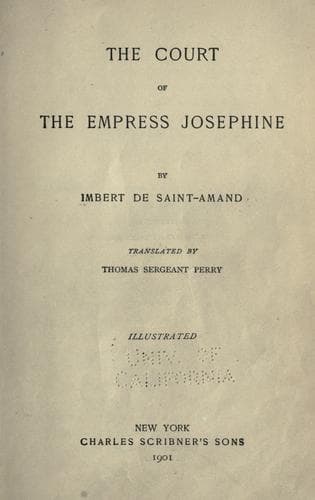
The Court of the Empress JosephineImbert de Saint-Amand
History
The Court of the Empress Josephine
Imbert de Saint-Amand
Josephine, Empress, consort of Napoleon I, Emperor of the French, 1763-1814
Bonaparte, commander of the Army of the Interior, after the 13th
Vendemiaire, when he saved the expiring Convention, had just ordered the
disarmament of the sections and the delivery of all arms found in private
houses, when a boy of fourteen called upon him to ask to have back the
sword of his father, who had commanded the armies of the Republic. This
boy was Eugene de Beauharnais, afterwards Viceroy of Italy. Bonaparte,
touched by this action, received him graciously. The next day Madame de
Beauharnais called upon him to thank him. He was much struck by her charms
and proposed to her; she accepted him and they were married March 9, 1796.
The Viscountess of Beauharnais became Citizeness Bonaparte. No sooner
married, than the young husband, who was only twenty-six, tore himself
from her arms and started for the army of Italy. Then Napoleon's love for
Josephine was much greater than hers for him. It was he who was jealous,
he who wrote burning letters; he it was who was all enthusiasm, ardor, and
ablaze with passion. It was only with reluctance that Josephine decided to
leave Paris, where she was happy, but in Italy she found a real royalty.
At Milan she took possession of the Serbelloni Palace, where she did the
honors most admirably and received the homage of the proud aristocracy of
Milan. She followed her husband to the war, for he could not bear to be
separated from her, and one day when, beset with dangers, she was crying,
he exclaimed: "Wurmser shall pay dearly for the tears he causes you."
After Arcole, Madame Bonaparte resembled a sovereign. She singularly aided
her husband to play the double part which was soon to carry him to the
highest rank. When it was a question of repelling royalism, the young
conqueror relied on men like Augereau; when it was necessary to attract
men of the old regime, Josephine was the bond of union between him and the
French or Italian aristocracy. On her return to Paris, June 2, 1798, she
shared her husband's glories. The little house in the rue Chantereine
became more famous than the grandest palaces.
Public-domain text, read in full here on John Shaqi.
Reviews
Reviews
No reviews yet
Be the first to share your thoughts on this work.
Elsewhere in the archive
Join the Discussion
Join the discussion
Sign in to leave a comment or review.
Sign InorCreate an account