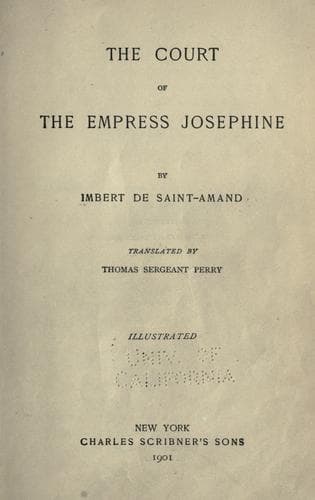
The Court of the Empress JosephineImbert de Saint-Amand
History
The Court of the Empress Josephine
Imbert de Saint-Amand
Josephine, Empress, consort of Napoleon I, Emperor of the French, 1763-1814
The study of any court is sure to teach wisdom and indifference to human
glories. In our France of the nineteenth century, fickle as it has been,
inconstant, fertile in revolutions, recantations, and changes of every
sort, this lesson is more impressive than it has been at any period of our
history. Never has Providence shown more clearly the nothingness of this
world's grandeur and magnificence. Never has the saying of Ecclesiastes
been more exactly verified: "Vanity of vanities; all is vanity!" We have
before us the task of describing one of the most sumptuous courts that has
ever existed, and of reviewing splendors all the more brilliant for their
brevity. To this court of Napoleon and Josephine, to this majestic court,
resplendent with glory, wealth, and fame, may well be applied Corneille's
lines:--
"All your happiness
Subject to instability
In a moment falls to the ground,
And as it has the brilliancy of glass
It also has its fragility."
We shall evoke the memory of the dead to revive this vanished court, and
we shall consult, one after another, the persons who were eye-witnesses of
these short-lived wonders. A prefect of the palace, M. de Bausset, wrote:
"When I recall the memorable times of which I have just given a faint
idea, I feel, after so many years, as if I had been taking part in the
gorgeous scenes of the _Arabian Tales_ or of the _Thousand and One
Nights_. The magic picture of all those splendors and glories has
disappeared, and with it all the prestige of ambition and power." One of
the ladies of the palace of the Empress Josephine, Madame de Remusat, has
expressed the same thought: "I seem to be recalling a dream, but a dream
resembling an Oriental tale, when I describe the lavish luxury of that
period, the disputes for precedence, the claims of rank, the demands of
every one." Yes, in all that there was something dreamlike, and the actors
in that fairy spectacle which is called the Empire, that great show piece,
with its scenery, now brilliant, now terrible, but ever changing, must
have been even more astonished than the spectators. Aix-la-Chapelle and
the court of Charlemagne, the castle of Fontainebleau and the Pope, Notre
Dame and the coronation, the Champ de Mars and the distribution of eagles,
the Cathedral of Milan and the Iron Crown, Genoa the superb and its naval
festival, Austerlitz and the three emperors,--what a setting! what
accessories! what personages! The peal of organs, the intoning of priests,
the applause of the multitude and of the soldiers, the groans of the
dying, the trumpet call, the roll of the drum, ball music, military bands,
the cannon's roar, were the joyful and mournful harmonies heard while the
play went on. What we shall study amid this tumult and agitation is one
woman. We have already studied her as the Viscountess of Beauharnais, as
Citizeness Bonaparte, and as the wife of the First Consul. We shall now
study her in her new part, that of Empress.
Public-domain text, read in full here on John Shaqi.
Reviews
Reviews
No reviews yet
Be the first to share your thoughts on this work.
Join the Discussion
Join the discussion
Sign in to leave a comment or review.
Sign InorCreate an account