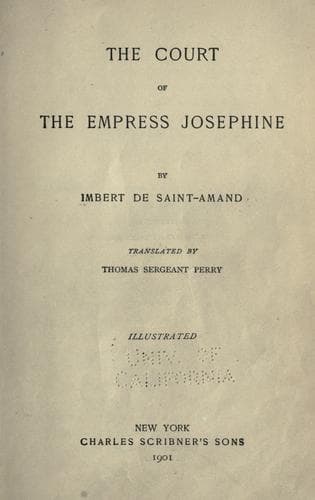
The Court of the Empress JosephineImbert de Saint-Amand
History
The Court of the Empress Josephine
Imbert de Saint-Amand
Josephine, Empress, consort of Napoleon I, Emperor of the French, 1763-1814
All Paris was excited by the approach of the great event. The hotels were
crowded; the population of the capital was nearly doubled, so vast was the
throng of provincials and foreigners. Tradesmen were working night and day
to prepare the dresses and uniforms. In every workshop there was
unparalleled activity. Leroy, who previously had been only a milliner, had
decided for this occasion to undertake dressmaking, and had made Madame
Raimbault, a celebrated dressmaker of the time, his partner. From their
shop came the magnificent robes to be worn by the Empress on Coronation
Day. Her jewels, consisting of a crown, a diadem, and a girdle, were the
work of the jeweller Margueritte. The crown was formed of eight branches
meeting under a gold globe surmounted by a cross. The branches were set
with diamonds, four in the shape of a palm leaf, four in the shape of a
myrtle leaf. Around the curve was a ribbon, inlaid with eight enormous
emeralds. The frontlet was bright with amethysts. The diadem was formed of
four rows of pearls interlaced with diamond leaves, with many large
brilliants, one alone weighing one hundred and forty-nine grains. The
girdle was a gold band, enriched with thirty-nine pink gems. The Emperor's
sceptre had been made by Odiot; it was of solid silver, enlaced by a gold
serpent, and surmounted by a globe on which was a miniature figure of
Charlemagne seated. The hand of justice, the crown, and the sword came
from the workshops of Biennais. The dress of the courtiers was to be very
magnificent; it consisted of a French coat of different colors according
to the duties of the wearer under the Grand Marshal, the High Chamberlain,
and the Grand Equerry, with silver embroidery for all; a cloak worn over
one shoulder, of velvet, lined with satin: a scarf, a lace band, and the
hat caught up in front, and adorned with a feather. The women were to
appear in ball dress, with a train, with a collar of blond-lace, called a
_cherusque_, which was fastened on both shoulders and rose high behind the
head, recalling the fashions of the time of Catherine de' Medici.
There were rehearsals of the coronation as if it were a spectacular play.
Every one, from the principal actors to the most insignificant assistants,
studied his part most conscientiously; the Masters of Ceremonies were to
act as prompters to those who might forget. The Imperial carriages and
those of the Princes and Princesses one morning were all driven empty to
the neighborhood of Notre Dame, that coachman, postilions, and grooms
might know the route they were to take, and when they were to draw up. The
carriages were superb, the horses magnificent, the liveries sumptuous.
Never in the most extravagant days of the monarchy had such luxury been
seen.
Public-domain text, read in full here on John Shaqi.
Reviews
Reviews
No reviews yet
Be the first to share your thoughts on this work.
Join the Discussion
Join the discussion
Sign in to leave a comment or review.
Sign InorCreate an account