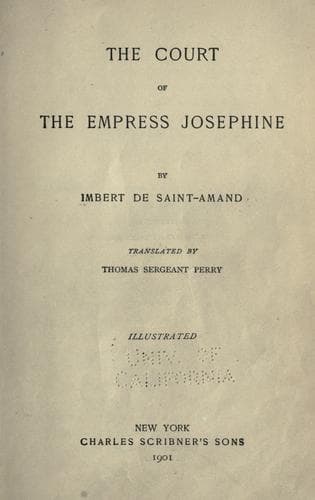
The Court of the Empress JosephineImbert de Saint-Amand
History
The Court of the Empress Josephine
Imbert de Saint-Amand
Josephine, Empress, consort of Napoleon I, Emperor of the French, 1763-1814
The Empress's costume was no less magnificent. She wore a dress, with a
train, of silver brocade covered with gold bees; her shoulders were bare,
but on her arms were tight sleeves embroidered with gold, the upper part
adorned, with diamonds, and fastened to them was a lace ruff worked with
gold which rose behind half up her head. The tight-fitting dress had no
waist, after the fashion of the time, but she wore a gold ribbon as a
girdle, set with thirty-nine pink gems. Her bracelets, ear-rings, and
necklace were formed of precious stones and antique cameos. Her diadem
consisted of four rows of pearls interlaced with clusters of diamonds. The
Empress, whose hair was curled, after the fashion of the reign of Louis
XIV., although forty-one years old, looked, according to Madame de
Remusat, no more than twenty-five. The Emperor was much struck by
Josephine's beauty in this sumptuous attire; all this luxury impressed
him. He recalled the days of his childhood, and turning to his favorite
brother, he said: "Joseph, if father could see us!"
Nine o'clock sounded, the hour set for the departure of the Pope, who was
to reach Notre Dame before the Emperor. The Sovereign Pontiff, clad in
white, went down the staircase of the Pavilion of Flora and entered his
carriage, which was drawn by eight horses; above it was a large tiara. At
Rome it was the custom that when the Pope went forth to officiate at one
of the great churches,--for instance, to Saint John Lateran,--for one of
his chamberlains to start a moment before him, mounted on a mule, and
carrying a great processional cross. Pius VII. asked that the same thing
might be done at Paris; consequently the pontifical procession was headed
by a chamberlain whose mule did not fail to amuse the vast crowd that
lined the quays; yet when the Pope passed, all knelt down and received his
blessing with due respect. With cavalry in front and behind, the Pope's
carriage and the eight carriages in which were the cardinals, Italian
prelates and officers who had come from Rome with him, drove slowly along
the quays to the Archbishop's Palace. There were awaiting him all the
French cardinals, archbishops, and bishops, and he was received by the
Cardinal du Belloy, the Archbishop of Paris, as he entered to put on his
pontifical robes. The pontifical procession entered Notre Dame in the
following order; a priest, carrying the apostolic cross; seven acolytes,
carrying the seven golden candlesticks; more than a hundred bishops,
archbishops or cardinals, in cope and mitre, marching two by two; and last
of all the Holy Father, his tiara on his head, under a canopy between two
cardinals who held up the ends of his golden cope. The clergy intoned the
hymn _Tu es Petrus_, which was very impressive, and the Sovereign Pontiff,
after kneeling for a few moments before the high altar, took his seat in
the middle of the choir on the pontifical throne, above which was a dome
adorned with the coat-of-arms of the church.
Public-domain text, read in full here on John Shaqi.
Reviews
Reviews
No reviews yet
Be the first to share your thoughts on this work.
Join the Discussion
Join the discussion
Sign in to leave a comment or review.
Sign InorCreate an account