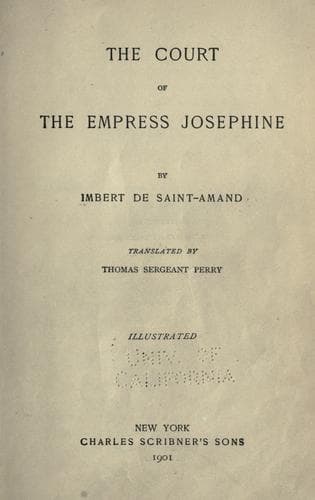
The Court of the Empress JosephineImbert de Saint-Amand
History
The Court of the Empress Josephine
Imbert de Saint-Amand
Josephine, Empress, consort of Napoleon I, Emperor of the French, 1763-1814
great lords, by regicides and by Royalists and ecclesiastics. It seemed as
if with him everything began, or rather started anew. "The old world was
submerged," says Chateaubriand; "when the flood of anarchy withdrew,
Napoleon appeared at the beginning of a new world, like those giants
described by profane and sacred history at the beginning of society,
appearing on earth after the Deluge."
The former general of the Revolution enjoyed his situation as absolute
sovereign. He studied the laws of etiquette as closely as he studied the
condition of his troops. He saw that the men of the old regime were more
conversant in the art of flattery, more eager than the new men. As Madame
de Stael says: "Whenever a gentleman of the old court recalled the ancient
etiquette, suggested an additional bow, a certain way at knocking at the
door of an ante-chamber, a ceremonious method of presenting a despatch, of
folding a letter, of concluding it with this or that formula, he greeted
as if he had helped on the happiness of the human race." Napoleon
attached, or pretended to attach, great importance to the thousand
nothings which up the life of courts. He established in the palace the
same discipline as in the camps. Everything became a matter of rule.
Courtiers studied formalities as officers studied the art of war.
Regulations were as closely observed in the drawing-rooms as in the tents.
At the end of a few months Napoleon was to have the most brilliant, the
most rigid court of Europe. At times the whirl of vanities surrounded him
filled with impatience the great central sun, without whom his satellites
would have been nothing. At other times, however, his pride was gratified
by the thought that it was his will, his fancy, which evoked from nothing
all the grandees of the earth. He was not pained at seeing such eagerness
in behalf of trifles that he had invented. He liked to fill his courtiers
with raptures or with despair, by a smile or a frown. He thought his
sisters' ambition childish, but it amused him; and if they had to cry a
little at first, he finally granted them what they wanted.
Public-domain text, read in full here on John Shaqi.
Reviews
Reviews
No reviews yet
Be the first to share your thoughts on this work.
Join the Discussion
Join the discussion
Sign in to leave a comment or review.
Sign InorCreate an account