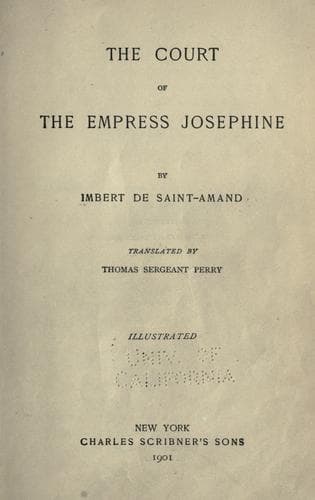
The Court of the Empress JosephineImbert de Saint-Amand
History
The Court of the Empress Josephine
Imbert de Saint-Amand
Josephine, Empress, consort of Napoleon I, Emperor of the French, 1763-1814
April 12, the Empress held a reception. The _Bulletin of Lyons_ thus
described it: "The assembly was most brilliant. As our sovereign has
exhibited in his audiences profundity, affability, exact and varied
learning, and true greatness, so his august wife has shone with grace,
courtesy, and gentleness. Thus we witness a revival of that old French
urbanity and politeness of manners which have always distinguished our
court, and have made it an example and an object of admiration for all
foreign courts."
The city offered Napoleon and Josephine an entertainment at the Grand
Theatre. The back-scene represented the Emperor, seated, clad in a long
triumphal robe. Two allegoric figures, representing, one, France, the
other, Italy, with their feet resting on clouds, held in their hands a
roll bearing this inscription: _Sublimi feriam sidera vertice_, "I shall
strike the stars with my lofty head"; with the other, they each offered a
crown to Napoleon. Thus did flattery renew the apotheoses of the Caesars
of ancient Rome.
There was sung a cantata entitled _Ossian's Dream_. The young men of the
National Guard of Lyons and the leading ladies of the city waltzed before
the throne. Two young girls held each a basket into which the dancers
threw flowers as they passed by; out of these flowers the girls wove two
crowns which, after the dance, they presented to the Emperor and Empress.
April 29, Napoleon and Josephine were present at a grand performance at
the Grand Theatre in Turin. They stayed at the castle of Stupinizi, just
outside of the city, where they bade farewell to Pius VII., who had
celebrated the Easter festival at Lyons, and was on his way to Rome.
The Emperor and the Empress reached Alessandria May 2, at ten in the
morning, amid the roar of cannon and the ringing of church-bells. Napoleon
spent the day in revisiting the battle-field of Marengo, where he gave the
Empress a mimic representation of the battle he had won five years before.
From a throne he watched the manoeuvres executed under the command of
Murat, Lannes, and Bessieres. He had had the coat and hat he wore on the
day of the battle brought from Paris. The coat was somewhat moth-eaten,
and the odd hat would have seemed very much out of date if it had not
recalled such precious memories. But Napoleon liked to recall that
eventful day when he had managed to grasp victory when apparently beaten.
After the manoeuvres he solemnly laid the corner-stone of a monument to
the memory of Desaix and the other brave men who fell at Marengo.
Public-domain text, read in full here on John Shaqi.
Reviews
Reviews
No reviews yet
Be the first to share your thoughts on this work.
Elsewhere in the archive
Join the Discussion
Join the discussion
Sign in to leave a comment or review.
Sign InorCreate an account