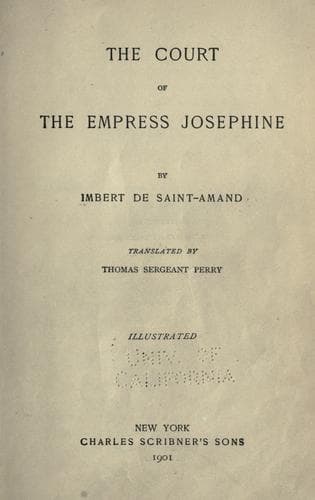
The Court of the Empress JosephineImbert de Saint-Amand
History
The Court of the Empress Josephine
Imbert de Saint-Amand
Josephine, Empress, consort of Napoleon I, Emperor of the French, 1763-1814
At Alessandria, the next day, he had an interview with his brother Jerome,
which in fact was a reconciliation. In 1808, after the breaking of the
Peace of Amiens, Jerome Bonaparte, who then, a young man of twenty, was in
the naval service, happened to be forced by an English cruiser to land in
the United States. There he had fallen in love with the young and charming
daughter of a rich merchant of Baltimore, Miss Elisabeth Paterson, and he
married her. Napoleon was unwilling to recognize this marriage. No sooner
had he ascended the throne than he at once exhibited all the feeling and
prejudices of a monarch who belonged to a dynasty of the most venerable
antiquity. He really believed that his brothers could marry only
princesses, and that any other marriage was an unpardonable mesalliance.
If, possibly, Napoleon was able to condemn Lucien's wife for her past
conduct, no such criticism could apply to the wife of Jerome, who was a
young woman of conspicuous morality, intelligence, and amiability. But she
was the daughter of a ship-owner, a merchant, and thus was not a proper
match, he thought, for the brother of the powerful monarch who was already
dreaming of restoring the vassal kingdoms and the whole vast imperial
edifice of Charlemagne. He, the Emperor of the French, the King of Italy,
did not like to remember that he had wedded a simple subject, and that he
had been very proud of his marriage. He could not pardon his brother
Jerome for making a love-match. He would not even listen to his defence of
his young wife, soon to be a mother, and who deserved only respect and
pity, and who, humiliated, abandoned, and brokenhearted, was about to be
treated as a concubine, and driven away forever. Ambition had destroyed
Napoleon's natural kindliness. Yet, if he had seen Jerome's wife, a
devoted and interesting woman, warmly attached to her husband, and alive
to her duties, probably he would have taken pity on her. Possibly he was
himself aware of this, for he forbade the unhappy young woman to enter any
part of the Empire, and compelled this innocent victim of political
considerations to take refuge in England, as if she were a criminal.
Public-domain text, read in full here on John Shaqi.
Reviews
Reviews
No reviews yet
Be the first to share your thoughts on this work.
Elsewhere in the archive
Join the Discussion
Join the discussion
Sign in to leave a comment or review.
Sign InorCreate an account