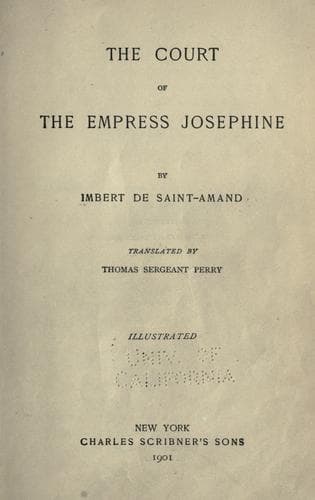
The Court of the Empress JosephineImbert de Saint-Amand
History
The Court of the Empress Josephine
Imbert de Saint-Amand
Josephine, Empress, consort of Napoleon I, Emperor of the French, 1763-1814
February 22, 1805, Napoleon had compelled his mother, Madame Letitia, to
place in the hands of a notary, Raguideau, a protest against Jerome's
marriage, on the pretext that he, having been born November 15, 1784, was
not yet twenty at the date of his marriage, and according to the law of
September 20, 1792, a marriage contracted by any one under twenty without
the consent of his father and mother was null and void. The _Moniteur_ of
the 13th Ventose, Year XIII. (March 4, 1805), had contained the following
lines: "11th Ventose. By an act dated to-day, all the civil officers of
the Empire are forbidden to receive on their registers a copy of the
certificate of an alleged marriage contracted by M. Jerome Bonaparte in a
foreign country, when under age, and without his mother's consent, and
without previous publication in the place where he is domiciled." A few
days later this appeared in the _Moniteur_: "M. Jerome Bonaparte has
arrived at Lisbon in an American ship; in the passenger list were the
names of Mr. and Miss Paterson, M. Jerome at once took port for Madrid,
Mr. and Miss Paterson have re-embarked. They are supposed to be returning
to America."
Jerome, in obedience to the Emperor's orders, started from Portugal for
Italy, posting day and night at full speed, through Badajoz, Madrid,
Perpignan, and Grenoble, He says in his Memoirs: "Amid the mountains of
Estremadura, his modest carriage encountered the almost royal train of the
French Ambassador to Portugal. It was Junot whom he had left a simple
aide-de-camp of the First Consul, and saw again one of the first
personages of the Empire. Madame Junot, an old friend from childhood of
Jerome, was with her husband. This interview was a most interesting one,
partly from the deserted spot where they met, and partly from the great
events that had occurred since their separation."
Junot and his wife found Jerome much improved. He had become more serious;
a certain gravity had taken the place of his youthful bubbling high
spirits. He spoke with emotion, respect, and affection of his young wife
whose pathetic situation was made even more disturbing by the state of her
health. He proposed to throw himself at his brother's feet, and by prayers
and supplications to wring from him the consent he desired. "No one can
doubt," he says in his Memoirs, "that his heart was torn by the keenest
agitations, to say nothing of the anxiety about his wife; the
mortification at two years of inactivity, during which his comrades,
friends, and relatives had worked, fought, and become great; the regret
for the lofty position he had lost; the hope of regaining it; his fear of
his brother's wrath which he had ventured to arouse, and which made kings
tremble on their thrones."
Public-domain text, read in full here on John Shaqi.
Reviews
Reviews
No reviews yet
Be the first to share your thoughts on this work.
Elsewhere in the archive
Join the Discussion
Join the discussion
Sign in to leave a comment or review.
Sign InorCreate an account