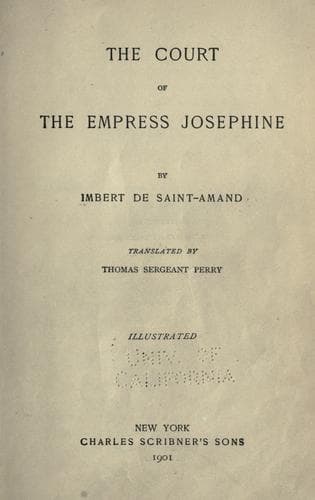
The Court of the Empress JosephineImbert de Saint-Amand
History
The Court of the Empress Josephine
Imbert de Saint-Amand
Josephine, Empress, consort of Napoleon I, Emperor of the French, 1763-1814
"Alessandria, May 6, 1805. MY BROTHER: Your letter of this morning informs
me of your arrival at Alessandria. There is no fault which cannot be
effaced in my eyes by repentance. Your marriage with Miss Paterson is null
in the eyes of both religion and law. Write to Miss Paterson to return to
America. I will grant her a pension of sixty thousand francs for life, on
condition that she shall never bear my name, a right which does not belong
to her in the non-existence of the marriage. You must tell her that you
could not and cannot change the nature of things. When your marriage is
thus annulled by your own will, I will restore to you my friendship, and
resume the feelings I have had for you since your infancy, hoping that you
will show yourself worthy of them by the efforts you will make to win my
gratitude and to acquire distinction in the army."
A few days later Napoleon wrote to the Minister of the Navy: "M. Decres,
M. Jerome has arrived. He has confessed his errors and disavows this
person as his wife. He promises to do wonders. Meanwhile I have sent him
to Genoa for some time."
After his reconciliation with Jerome, Napoleon went to Pavia, where the
magistrates presented to him the homage of his new capital, and he entered
that city, with the Empress, May 8, amid the roar of cannon and the
ringing of bells.
XIII.
THE CORONATION AT MILAN.
By descent, by his physical, moral, and intellectual nature, by his
imagination and genius, Napoleon was much more an Italian than a
Frenchman. His father and mother were Italians, his ancestors were
Italian, and Italian was his mother-tongue. His family and Christian names
were Italian. His mother spoke French with the strongest Italian accent.
He had loved Corsica before he loved France. As a child, he had felt the
greatest enthusiasm for Paoli, the Corsican patriot, and had then looked
upon the French as foreigners and oppressors. His face not only resembled
that of an Italian, but that of an ancient Roman. By a singular
coincidence, he had the head of a Caesar. Italy was not only the home of
his family, it was there that he laid the foundations of his glory. That
unrivalled country, as one of our poets calls it, had brought him good
fortune. There he wrote the famous bulletins of his first victories; there
he began to impress the popular imagination; and it was through Italy that
he subjugated France. There he felt at home. The people of that peninsula
greeted him as a fellow-countryman. He liked to speak their language to
them, charmed by its harmony and sincerity. His Southern genius rejoiced
in its bright skies which lent everything such lustre, and well suited the
conqueror's thoughts. He perhaps preferred Milan to Paris as a place to
live in.
Public-domain text, read in full here on John Shaqi.
Reviews
Reviews
No reviews yet
Be the first to share your thoughts on this work.
Elsewhere in the archive
Join the Discussion
Join the discussion
Sign in to leave a comment or review.
Sign InorCreate an account