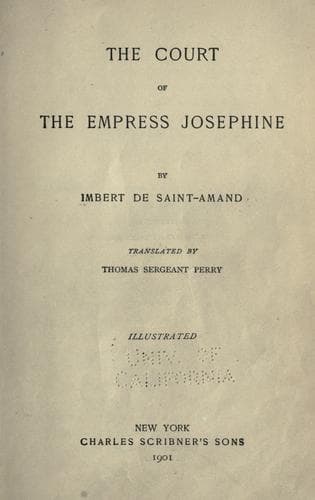
The Court of the Empress JosephineImbert de Saint-Amand
History
The Court of the Empress Josephine
Imbert de Saint-Amand
Josephine, Empress, consort of Napoleon I, Emperor of the French, 1763-1814
His formal entrance into the capital of his kingdom of Italy had been
skilfully arranged. Cardinal Caprara, the Archbishop of that city, had
great influence there, and he was never tired of speaking to his flock
about the services Napoleon had rendered to the Catholic religion. The
Grand Master of Ceremonies, M. de Segur, who reached Milan a few days
before the Emperor, charmed the best society of Lombardy by his pleasant
wit and delightful manners, and induced the most illustrious families to
solicit the honor of figuring among the ladies and officers in waiting at
the palace of the King and Queen of Italy, as Napoleon and Josephine were
called at Milan.
The first visit which the King and Queen made in this capital was to the
famous Cathedral. There they fell on their knees, and the Milanese were
much touched by the spectacle. The _Italian Journal_, in its official
account of Napoleon's entrance into Milan, uttered these dithyrambics: "It
is impossible to imagine a more brilliant day than that which yesterday
adorned our capital, when Bonaparte, the hero of the age, our adored
monarch, entered within our walls. This day will be forever memorable in
the chronicles of our history. Milan saw entering its gates, bearing the
proud name of King, the same hero who had already been proclaimed
conqueror, liberator, peace-maker, and legislator, and who to-day, under
his august Empire, assures that greatness to which his victories and his
genius permit us to aspire. The Emperor entered by the gate named after
his most glorious triumph, the Marengo Gate."
On reaching Milan, Napoleon exchanged the decorations of the Legion of
Honor for the oldest orders of chivalry in Europe. He received from the
Minister of Prussia the Black and the Red Eagle; from the Spanish
Ambassador, the Golden Fleece; from the Ministers of Bavaria and Portugal,
the Orders of Saint Hubert and Christ respectively; and he gave them the
broad ribbon of the Legion of Honor. When he had received besides foreign
decorations for the principal men of the Empire, he granted an equal
number of his own. May 12, wearing the broad ribbon of the Black Eagle, he
went with the Empress to the theatre of La Scala and saw the opera of
_Castor and Pollux_. The theatre, which was brilliantly lit, was crowded
with the fair ladies of Milan, resplendent in full dress and jewels. The
elegance and splendor of these deservedly famous beauties, the brilliant
diversity of the uniforms, the sumptuousness of the Imperial box, and on
the stage the magnificence of the dresses and the scenery, the skill of
the singers, all combined to make the performance most memorable. That
day, after mass, Napoleon had ridden out, and had inspected the troops who
paraded on the Place of the Cathedral.
Public-domain text, read in full here on John Shaqi.
Reviews
Reviews
No reviews yet
Be the first to share your thoughts on this work.
Elsewhere in the archive
Join the Discussion
Join the discussion
Sign in to leave a comment or review.
Sign InorCreate an account