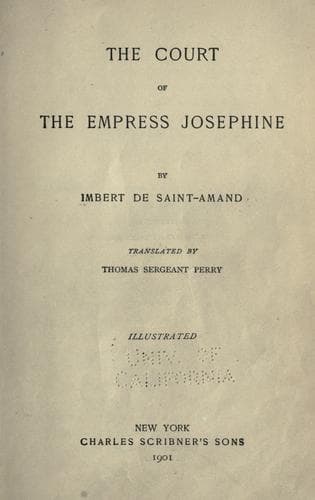
The Court of the Empress JosephineImbert de Saint-Amand
History
The Court of the Empress Josephine
Imbert de Saint-Amand
Josephine, Empress, consort of Napoleon I, Emperor of the French, 1763-1814
The next day the Emperor and Empress were at a ball given in the old Ducal
Palace. "The presence of Their Majesties in this superb building," says
the _Moniteur_, "the kindness with which they deigned to speak to every
one, gave this festivity a touching character. All who saw and heard our
sovereigns, rejoiced in their new destinies. The concert was followed by a
ball, and Their Majesties stayed through the several dances, leaving about
midnight. Their path was lit by numberless candles. On their way they met
a multitude, delighted even at that hour, to be able to discern some of
our monarch's features."
In spite of all these splendid ceremonies Josephine, though idolized, was
not happy. "In general," Mademoiselle Avrillon says with justice, "the
public has a very faint knowledge of the real feelings of those in the
highest station. Being often on show, they are obliged to assume a
fictitious character, just as they dress themselves for great ceremonies.
I have seen the Empress's sufferings, whom nothing could console for her
separation from her children, whom she loved above everything. Ambitions
were less to her than maternal love, her strongest feeling. The thought of
leaving her son in Italy, the fear of never seeing him again, or the
certainty of seeing him seldom, made her shed tears." One day when she was
in more distress than usual, Napoleon said to her: "You are crying,
Josephine; that's absurd; you are crying because you are going to be
separated from your son. If the absence of your children gives you so much
pain, judge what I must suffer. The affection you show them makes me feel
most acutely my unhappiness in having none." These words sounded in
Josephine's ears like a funeral knell. She saw the spectre of divorce
rising before her, and turned pale. From Genoa they went to Turin.
Napoleon heard there of the coalition preparing against him, and left
suddenly for France with Josephine. Non-commissioned officers of the
Grenadiers and the Chasseurs of the Guard served as escort, but they were
unable to keep up with the carriages, so the Emperor thanked them for
their zeal and pushed on without them. He did not stop once for twenty-
four hours. Josephine, who never tormented her husband by complaining, did
not say a word about the fatigues of this quick journey. After an absence
of a hundred days, they reached Fontainebleau, July 11. No one expected
them and no preparations had been made for their reception. Their
departure from Turin had been so recent, and it resembled a flight. The
Emperor did not wish to be recognized on the way, and burst into
Fontainebleau like a bombshell. The palace porter was an old servant,
named Guillot, who had been Napoleon's cook in Egypt. "Well," the Emperor
said to him, "you must go back to your old business and cook us some
supper." Fortunately the porter had in his sideboard some mutton-chops and
eggs. He set to work, and Napoleon ate this improvised meal with great
relish.
Public-domain text, read in full here on John Shaqi.
Reviews
Reviews
No reviews yet
Be the first to share your thoughts on this work.
Elsewhere in the archive
Join the Discussion
Join the discussion
Sign in to leave a comment or review.
Sign InorCreate an account