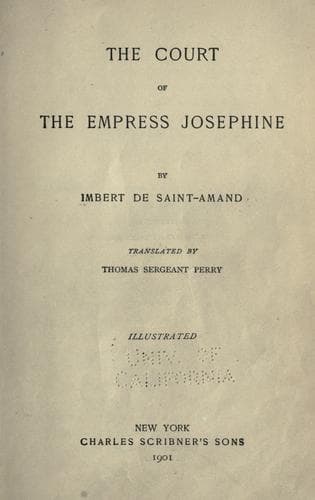
The Court of the Empress JosephineImbert de Saint-Amand
History
The Court of the Empress Josephine
Imbert de Saint-Amand
Josephine, Empress, consort of Napoleon I, Emperor of the French, 1763-1814
Josephine borrowed some linen from one of her old chambermaids.
The Emperor asked for a full account of everything that had happened in
Paris during his absence, and began to draw up the plans which were to be
accomplished at Austerlitz before the end of the year. July 18, at one in
the afternoon, he arrived at Saint Cloud, accompanied by the Empress, amid
the roar of the cannon at the Invalides. That evening they went into the
city, called on Napoleon's mother, and went to the opera, where the
_Pretendus_ was given; the audience greeted them most warmly. After all
the splendor of the Italian festivities the time had come for military
preparations and warlike thoughts.
XV.
DURING THE CAMPAIGN OF AUSTERLITZ.
Austerlitz was to be for the Empire what Marengo had been for the
Consulate: a consolidation. In spite of the pomps of the double
coronation, Napoleon did not feel firmly established on his Imperial and
Royal throne. Opinions varied with regard to the stability of the new
regime. The Liberals missed the Republic, and the Royalists the Bourbons.
If the army and the people showed confidence in the Emperor's star, the
Parisian middle class was always cool, and business men observed with
anxiety the hostility of England, Austria, Russia, and possibly Prussia.
Paris was gloomy; business was dull; the absence of the court depressed
the shop-keepers; the theatres were empty; in short, the winter was
infinitely less gay than the one before. There was general uneasiness;
wives feared for their husbands; mothers for their sons. Every one had
become used to the peace which had lasted five years, and the renewal of
war inspired the greatest anxiety.
As for Napoleon, he felt the need of some great stroke that should
astonish and fascinate the world. He understood that to maintain his fame
he was condemned to work miracles. September 23, 1805, he had exposed to
the Senate the hostile conduct of Austria, and had announced his speedy
departure to carry aid to the Elector of Bavaria, the ally of France, whom
the Austrians had just driven from Munich. Five days later he had started,
confident of success, and certain that he would find his people at his
feet on his return. The Empress accompanied him as far as Strassburg, and
established herself there to be near the scene of war and to receive
earlier news than was possible at Paris.
Public-domain text, read in full here on John Shaqi.
Reviews
Reviews
No reviews yet
Be the first to share your thoughts on this work.
Elsewhere in the archive
Join the Discussion
Join the discussion
Sign in to leave a comment or review.
Sign InorCreate an account