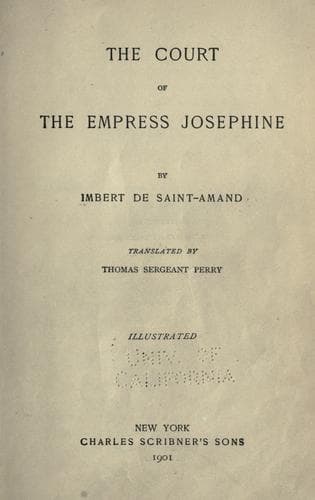
The Court of the Empress JosephineImbert de Saint-Amand
History
The Court of the Empress Josephine
Imbert de Saint-Amand
Josephine, Empress, consort of Napoleon I, Emperor of the French, 1763-1814
We have in the Memoirs of General de Segur, an eye-witness, an interesting
account of the eve of Austerlitz. Late in the afternoon Napoleon entered a
hut, and took his place at table in the best of spirits, along with Murat,
Caulaincourt, Junot, Segur, Rapp, and a few other guests. They thought
that he would talk about the next day's battle. Not at all: he discussed
literature with Junot, who was familiar with all the new tragedies; he had
a good deal to say about Raynouard's _Templars_, about Racine, Corneille,
and the fate of the ancient drama. Then, by a singular transition, he
began to talk about his Egyptian campaign. "If I had captured Acre," he
said, "I should have put my army into long trousers, and have made it my
sacred battalion, my Immortals, and have finished my war against the Turks
with Arabians, Greeks, and Armenians. Instead of fighting here in Moravia,
I should be winning a battle of Issus, and be making myself Emperor of the
West, returning to Paris through Constantinople."
After dinner Napoleon wished to make a final reconnoissance of the enemy's
position by their bivouac fires; he mounted his horse and rode out between
the lines. One moment he came near paying dear for his imprudence; he went
too far forward and suddenly fell on a post of Cossacks, and had it not
been for the devotion of the chasseurs who escorted him, he would have
been killed or captured, and he was scarcely able to escape at full
gallop. After crossing the stream which covered the front of the French
army, he dismounted and returned to his bivouac, from one watch-fire to
another, on foot. On his way he stumbled over the stump of a tree and fell
to the ground. Then a grenadier took some straw, rolled it up to something
like a torch, and lit it; other soldiers did the same thing; the camp was
illuminated, and the face of the great conqueror was plainly to be seen.
The next day was December 2, the anniversary of his coronation. "Emperor,"
shouted an old soldier, "I promise you in the name of the grenadiers of
the army that you will have to fight only with your eyes, and that to-
morrow we shall bring you the flags and artillery of the Russian army to
celebrate the anniversary of your coronation." Every one shouted applause.
Napoleon in vain tried to stop them. "Silence," he commanded, "until to-
morrow! think of nothing but sharpening your bayonets!" Shouts of "Long
live the Emperor!" were repeated. Along a line of two leagues blazed
thousands of fires and flames. The Russians wondered what was the cause of
this unusual brilliancy, and thought the French were retreating. Napoleon
was at first annoyed by this rapturous demonstration, but at last he was
touched by it, and passing through a number of bivouacs, all brightly lit,
he expressed his gratitude to his soldiers, saying it was the happiest
evening of his life. Then he went to his tent, snatched a little sleep,
and when he rose in the morning, said, "Now, gentlemen, we are beginning a
great day."
Public-domain text, read in full here on John Shaqi.
Reviews
Reviews
No reviews yet
Be the first to share your thoughts on this work.
Elsewhere in the archive
Join the Discussion
Join the discussion
Sign in to leave a comment or review.
Sign InorCreate an account