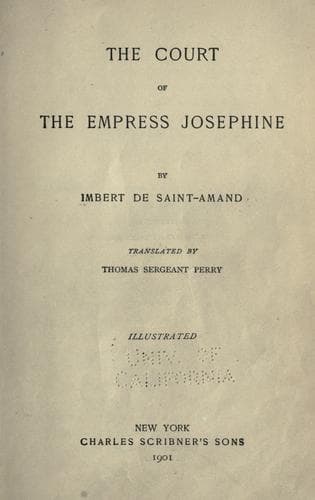
The Court of the Empress JosephineImbert de Saint-Amand
History
The Court of the Empress Josephine
Imbert de Saint-Amand
Josephine, Empress, consort of Napoleon I, Emperor of the French, 1763-1814
A moment later, the commanders of the different army corps, Murat, Lannes,
Bernadotte, Soult, Davout, came galloping up the little mound which the
soldiers called the Emperor's hill, to receive his final orders. It was a
solemn, impressive moment. "If I were to live," says General de Segur, "as
long as the world shall last, I shall never forget that scene.... Times
have changed quickly since then. Heavens! how great everything was then,
how brave the men, how glorious the time, how imposing the appearance of
fate!" Never was there a more brilliant triumph. "I have fought thirty
battles like that," said the conqueror, "but I have never seen so decisive
a victory, or one where the chances were so unevenly balanced." And then
full of admiration for his soldiers, he exclaimed; "I am satisfied with
you; you have covered your eagles with undying glory."
From a military point of view Austerlitz was Napoleon's greatest triumph.
War, which he loved with all its risks and emotions, then showed him its
most tempting side. He was always tempting fate, and fate had always
favored him. The hour had not yet struck when he was to ask more of
fortune than it could give. As Sainte-Beuve truly says, it was not till in
the icy plain of Eylau, from the cemetery covered with blood-stained snow,
that receiving the first warning of Providence, he had a sort of terrible
vision of what the future held in store for him. Then he had before his
eyes a sort of rehearsal of the horrors awaiting him in Russia, and at the
sight of so many corpses, and the awful scene, he said with deep
melancholy, "This sight is one to fill kings with love of peace and horror
of war." But at Austerlitz it was very different. The shrieks of the
Russians sinking through the holes torn in the ice by cannon-balls were
drowned in the shouts of the victors. The bright sunlight of that day of
triumph dispelled, all traces of gloom in the conqueror's heart.
December 3. Napoleon wrote thus to Josephine about his victory: "I
despatched Lebrun to you from the battle-field. I have beaten the Russian
and Austrian armies commanded by the two Emperors. I am a little tired. I
have bivouacked for a week in the open air, and the nights have been cool.
To-night I am going to sleep in the castle of Prince Kaunitz, where I
shall get two or three hours' rest. The Russian army is not merely
defeated, but destroyed. Much love." December 3, he had an interview in
his bivouac with the Emperor of Austria; and as if to apologize for the
wretched quarters in which he received him, he said, "This is the palace
which Your Majesty has compelled me to inhabit these three months." The
Emperor of Austria replied, "You make such good use of it, that you
certainly can't blame me on that account." And then the two Emperors
embraced.
Public-domain text, read in full here on John Shaqi.
Reviews
Reviews
No reviews yet
Be the first to share your thoughts on this work.
Elsewhere in the archive
Join the Discussion
Join the discussion
Sign in to leave a comment or review.
Sign InorCreate an account