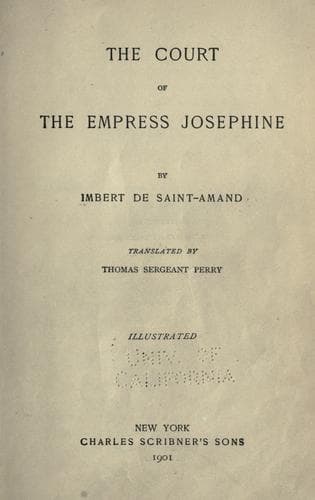
The Court of the Empress JosephineImbert de Saint-Amand
History
The Court of the Empress Josephine
Imbert de Saint-Amand
Josephine, Empress, consort of Napoleon I, Emperor of the French, 1763-1814
The day Napoleon wrote to Josephine: "I have made a truce. The Russians
withdraw. The battle of Austerlitz is the greatest I have won: forty-five
flags, more than one hundred and fifty cannon, the standards of the
Russian guards, twenty generals, more than twenty thousand killed,--a
horrid sight! The Emperor Alexander is in despair, and is leaving for
Russia. Yesterday I saw the Emperor of Germany in my bivouac; we talked
for two hours, and agreed on a speedy peace. The weather is not yet very
bad. Now that the continent is at peace, we may hope for it everywhere;
the English will be unable to face us. I shall see with pleasure the time
that will restore me to you. For two days a little trouble with the eyes
has been prevalent in the army. I have not yet been attacked. Good by, my
dear. I am fairly well, and very anxious to see you." December 3, there
was another letter, also from Austerlitz: "I have concluded an armistice,
and peace will be made within a week. I am anxious to hear that you have
reached Munich in good health. The Russians are going back after suffering
immense losses: more than twenty thousand killed and thirty thousand
captured; they have lost three-quarters of their army. Buxhoevden, their
commander-in-chief, is killed. I have three thousand wounded and seven or
eight hundred killed. I have a little trouble with my eyes: an epidemic;
it amounts to nothing. Good by; I am anxious to see you once more. To-
night I sleep in Vienna."
Cambaceres said that the news of the victory of Austerlitz filled the
populace with the wildest joy, which expressed itself in the most
extravagant flattery. The Emperor was treated like a god, and naturally a
sovereign so flattered did not control his love of war. It was only on his
deathbed that Louis XIV. said, "I have been overfond of war!" He said
nothing of the sort when the gates of Saint Martin and of Saint Denis were
built in his honor, when his statue was put up in the Place des Victoires,
when Lebrun painted the proud frescoes in the gallery at Versailles. Like
Louis XIV., Napoleon reproached himself with excessive love of war; but it
was not after Austerlitz, but after Waterloo. No man is worthy of
adoration; it belongs to God alone. Woe to the princes who are fed on
flattery! Extravagant laudation brings its punishment; even in this world
pride has its fall.
Public-domain text, read in full here on John Shaqi.
Reviews
Reviews
No reviews yet
Be the first to share your thoughts on this work.
Elsewhere in the archive
Join the Discussion
Join the discussion
Sign in to leave a comment or review.
Sign InorCreate an account