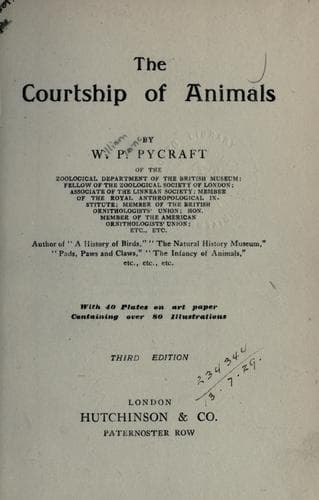
The Courtship of AnimalsPycraft, W. P. (William Plane)
Science
The Courtship of Animals
Pycraft, W. P. (William Plane)
Animal behavior; Natural selection
In the Pheasant we have an instance—one of hundreds—where the
resplendent dress is worn throughout the year. The next phase in the
direction of the growth of colour occurs when the female, towards old
age, develops a more or less well marked tendency to assume the hues
of her lord, and this accession of colour makes its appearance earlier
and earlier in succeeding generations, till finally the adults of both
sexes are coloured alike, save that, as a rule, the female lacks the
intensity of coloration which her mate displays. The original sombre
dress is now only worn by the young. In due course the resplendent
dress is assumed also by the young, as witness the numerous instances
among the Kingfishers and among the Parrots, where adults and young
are all habited in the same vivid hues. There are infinite variations
of these changes which cannot be discussed here, for obvious reasons.
All that matters now is the fact of such sequences, which inevitably
raise the questions: Why, in so many cases, do the females show no
disposition to assume resplendent colours? And to what factors can such
coloration, when it occurs, be attributed? The second only of these
questions is germane to the present discussion, and to this no very
satisfactory answer can be returned.
To say that the development of brilliance in species hitherto sombrely
clad is due to “changes in the metabolism” is only an affectation of
wisdom. What we want to know is what induces the changes? Time was
when no more than a guess could be hazarded as to this: a suggestion
that ornament, of whatever kind, was one of the many modes of the
expression of that instability of the organism which is characteristic
of living things: that it was one of the outward and visible signs of
that inward, intangible tendency to vary which is so familiar. Later
research seemed to show, fairly conclusively, that ornament was one
of those “secondary sexual characters” which was dependent on the
stimulating juices, or “hormones,” emanating from the primary sexual
glands. To-day it is manifest that this is only partly true, for it is
certain that these glands are not alone concerned and they may only
participate indirectly. It seems to have been clearly demonstrated that
the thyroid and pituitary glands, or the “hormones” therefrom, play a
large part in this matter of the “secondary sexual characters.”
Public-domain text, read in full here on John Shaqi.
Reviews
Reviews
No reviews yet
Be the first to share your thoughts on this work.
Elsewhere in the archive
Join the Discussion
Join the discussion
Sign in to leave a comment or review.
Sign InorCreate an account