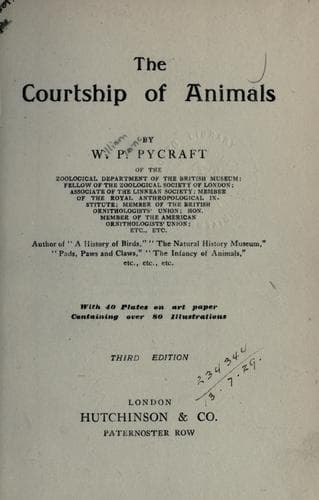
The Courtship of AnimalsPycraft, W. P. (William Plane)
Science
The Courtship of Animals
Pycraft, W. P. (William Plane)
Animal behavior; Natural selection
Castration, it is true, profoundly affects these characters. In the
case of Deer it inhibits the growth of antlers, in Cattle the horns
are increased in length but reduced in thickness—they are longer than
those of the female, but resemble them in appearance, and further,
the whole stature is greatly increased, but it is at the same time
conspicuously less massive, particularly at the neck and fore-quarters.
In eunuchs it results in immense stature and the loss of the more
characteristic male features, such as the beard and the bass voice. The
removal of the testes in birds is always a difficult operation and is
rarely successfully performed. Hence the accounts of changes in plumage
consequent on this operation are inconclusive. It has generally been
supposed that whenever, either by removal or by disease, the testes
are rendered inoperative the plumage, when normally of a resplendent
type, assumes the coloration of the female. This is probably an
erroneous supposition, but what happens is a failure to secrete the
more intense pigments and the more specialized forms of feathers, so
that the resultant dress answers to the juvenile male dress. It is
not a case of “reversion” to this livery, but a failure to assume the
latest acquirements of the species. These, as has already been shown,
are only very gradually developed. The intensity of pigmentation, or
concentration of pigmentation, which results in sharply defined areas
of colour, is a cumulative process. As it loses in intensity at any
given moult, so the individual tends to reproduce the phases of the
earlier and vanishing livery. Sooner or later, however, this earlier
livery disappears more or less completely: is eliminated from the
system, so to speak: and what is commonly called lack of “vigour”
results, not in a return to the earlier, sombre dress, but in the
later-acquired, resplendent plumage lacking intensity. The seasonal,
temporary secondary sexual character has become, as some say, a
“somatic” character. Highly probable as this view appears, it ought,
it may be argued, to receive support from nestling plumages. Young
gulls, for example, should occasionally revert from the mottled to the
earlier striped livery. But we have no evidence of this; and it does
not follow that this sequence of events should occur. The conditions of
control are different.
Public-domain text, read in full here on John Shaqi.
Reviews
Reviews
No reviews yet
Be the first to share your thoughts on this work.
Elsewhere in the archive
Join the Discussion
Join the discussion
Sign in to leave a comment or review.
Sign InorCreate an account