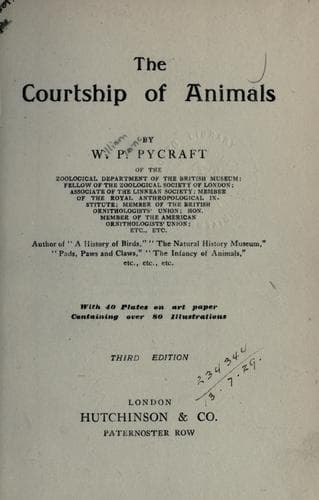
The Courtship of AnimalsPycraft, W. P. (William Plane)
Science
The Courtship of Animals
Pycraft, W. P. (William Plane)
Animal behavior; Natural selection
What exactly are the factors which govern the evolution of resplendent
plumage is not known. But they would seem to be more complex than
was supposed. That the primary sexual glands play an important part,
through the juices or “hormones” which they liberate, there can
be no doubt but these are only partial factors. The “hormones” of
the pituitary and thyroid glands are also necessary contributors,
controlling as they do both fertility and the more superficial
characters, such as colour and ornament. Evidence, indeed, is slowly
accumulating to show that the problem of the behaviour of animals
during the period of sexual activity, as well as the peculiarities
of structure and coloration which they develop at this time, are all
largely governed by the action of these secretions.
These, in their turn, are undoubtedly inhibited, or increased, by
the control of the nervous system, though this control is of course
involuntary. This much seems clear from the fact that birds will
display when under the excitement of fear, though the character of that
display is never the same as that in moments of sexual exaltation. If
the nervous system, through the eye, by “suggestion,” played no part,
there could be no use for display, but it is equally certain that for
the realization of the sexual activities a number of other factors have
to contribute.
The existence of this nexus of conditions is commonly overlooked, but
it is extremely important. Normally, not only among birds, but other
animals higher and lower in the scale of life, “suggestion” does not
suggest until the “hormones” concerned with the sexual activities have,
as it were, saturated the system and rendered it, so to speak, highly
inflammable. Even then it commonly happens that, with the male at any
rate, this inflammable state bursts into flame of its own accord. But
for this, indeed, how could the consummation—of the period of sexual
activity ever be realized? In many cases the sexes are sundered far
apart. What, but the merest accident, could bring them together if
it were not for this consuming fire of desire which impels each sex
to seek out the other? This stage is manifested in the case of the
Deer, where, we have seen, the stag wanders far and wide bellowing to
advertise his errand and listening for a response to his call. He is
possessed by a “male-hunger” which eventually attains to a state of
frenzy. Here no “suggestion” is needed, but the necessity for this
stimulus, for some form of aphrodisiac, occurs with him after the
first relief of his pent-up state has been attained. This stimulus is
applied, both through the eye and the sense of smell, by the females of
his herd. The same conditions apply in the case of the birds. But it is
to be noted that with the females, as in the case of mammals, sexual
desire is commonly less intense than in the males, and hence, in their
case the need for “suggestion” by display of some sort. But apart from
this, a “display” of some kind is necessary.
Public-domain text, read in full here on John Shaqi.
Reviews
Reviews
No reviews yet
Be the first to share your thoughts on this work.
Elsewhere in the archive
Join the Discussion
Join the discussion
Sign in to leave a comment or review.
Sign InorCreate an account