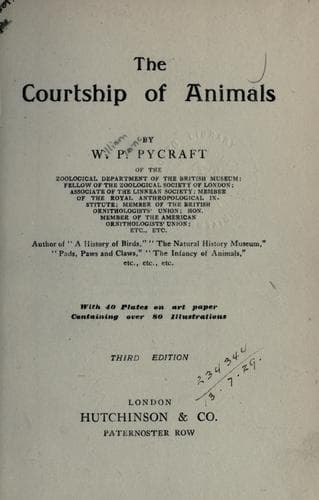
The Courtship of AnimalsPycraft, W. P. (William Plane)
Science
The Courtship of Animals
Pycraft, W. P. (William Plane)
Animal behavior; Natural selection
Mate-hunger among the fishes seems generally to find peaceable modes
of expression, either in “display” or in consorting in vast shoals,
though, so far, the factors which govern their conduct in this matter
are as yet unknown. But here, as with the higher vertebrates, there
are some species which adopt more violent methods. A good illustration
of such conduct is furnished by the Salmon, which, during the period
of sexual activity, develops a curious modification of the lower jaw,
which is produced forwards and upwards to form a hook-shaped projection
of fibrous tissue. When the mouth is closed this hook is received
into a cavity formed within the fore-part of the roof of the mouth.
It has been described as a weapon of offence. But this it can hardly
be. On the other hand it has been suggested that it serves to protect
the jaws when charging a rival, for the shock on such occasions is
considerable. It answers, in short, like to the fibrous mass of tissue
which protects the fore-part of the head in Whales like the Black Whale
(_Globicephalus_) and the Bottle-nose Whale (_Hyperoodon_), serving as
a battering-ram. In the Pacific Salmon (_Onchorhynchus_) both jaws are
hooked, so that when the mouth is closed the hooks cross one another
as in the beak of the Crossbill. In this Salmon, too, the front
teeth attain a considerable length, while the body becomes laterally
compressed and a hump forms at the shoulders. Little, however, seems to
be known as to the nature of their battles.
The combats of the Salmon of our own islands, however, are evidently
severe, and this has long been known, for Darwin speaks of as many
as three hundred, all with one exception males, being found dead in
the Tyne during the month of June, killed by fighting. Such battles
are fought, it is to be noticed, not so much for the possession of
females—for it is a polygamous fish—as for the privilege of fertilizing
the eggs as they are shed. The absence of a “display” here is a
noticeable feature, and it is on this account, probably, that the
reproductive period is not associated with the appearance of any form
of resplendent livery. On the contrary, the marvellous silvery sheen
which adorned both sexes on their arrival at the spawning ground from
the sea has entirely vanished by the time that the consummation of the
journey has been attained, and in its place is naught but a slimy,
dingy copper-coloured hue. But no sooner has the reproductive period
passed than the silver lustre makes its appearance once more.
Public-domain text, read in full here on John Shaqi.
Reviews
Reviews
No reviews yet
Be the first to share your thoughts on this work.
Elsewhere in the archive
Join the Discussion
Join the discussion
Sign in to leave a comment or review.
Sign InorCreate an account